Good morning, Slaters!Nvidia got its answer on Thursday. The bond market sent the bill. Jensen Huang resigned, and Nvidia (NVDA) fell 14% at its low before closing down 4.3%. Investors priced a missing founder in a morning. They did not price the cost of money nearly as fast. Cash Treasuries reopened after the holiday, the 10-year yield jumped to 5.10%, and small caps fell 1.7%. Overnight, the pressure kept moving. Bitcoin fell below $69,000 in Asian trading. The dollar touched 160 yen. And Huang's exit opened a second front on Capitol Hill. So the morning comes down to one release. October producer prices land shortly after this note does, and they will tell traders whether the bond market has already done the Fed's job. Let's get into it. 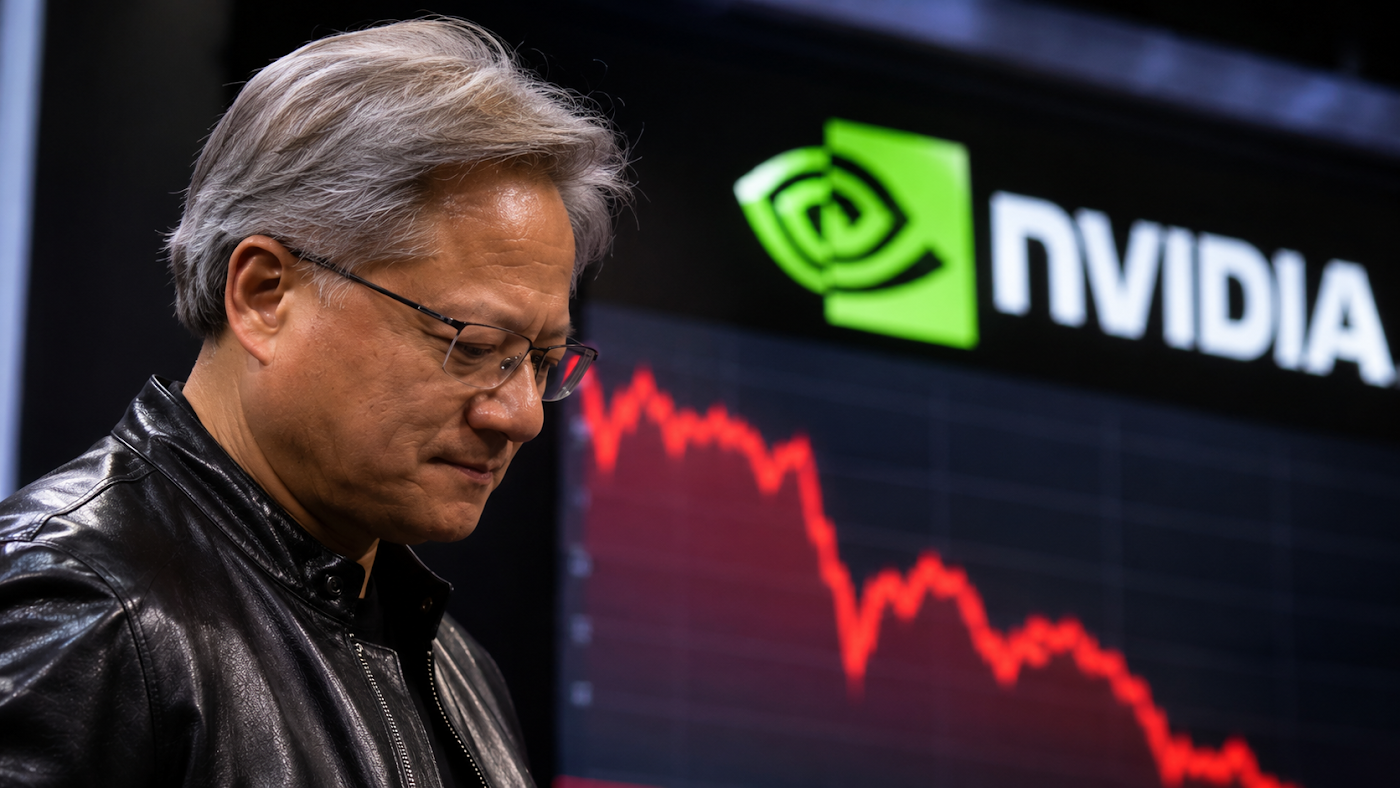
Daybreak Nvidia solved its key-person problem. The policy problem just got a hearing.Nvidia (NVDA) closed Thursday at $166.19, down 4.3%, on 740 million shares, the heaviest volume in the market. The range tells the real story. The stock opened at $150.99, touched $148.80 and finished more than 11% above its low. It was indicated higher again overnight. The board moved fast. Finance chief Colette Kress is interim chief executive and keeps the finance job, and director Harvey Jones became the company's first chair. Nvidia gave no reason for Huang's exit. Still, the question traders spent the week pricing is closed. Then came the part a board cannot fix. House Foreign Affairs Chairman Brian Mast said Huang agreed to testify to lawmakers behind closed doors after they threatened a subpoena. The date is still being negotiated. A CEO search solves a key-person problem. A congressional inquiry into export controls and China exposure is a policy problem, and no search committee can solve that. It lands as the president is scheduled to meet China's leader at an Asia-Pacific summit next week. The sell side moved as a block. Four brokerages cut the stock on the day, including Bernstein, which halved its target to $200. William Blair cut Nvidia and upgraded AMD (AMD) to outperform. AMD rose 5.9% while Nvidia fell. Read those two moves together. One reading is that investors are charging a leadership discount, not pricing a demand problem. At about 10.5 times consensus earnings for the fiscal year ending January 2028, bulls see an unchanged earnings stream on sale. The market signal? Nov. 17 is the first test, with Kress reporting as both chief executive and finance chief. A clean guide keeps the discount tied to the boardroom. The testimony is the second test. If it turns to export controls, the discount stops being about a name and starts being about the market Nvidia can sell into. If AMD keeps outrunning Nvidia for another week, Thursday's split was more than a one-day reaction. Pulse Check The two-year jumped 40 basis points in a week. Small caps, homes and gold paid first.Cash Treasuries reopened after Veterans Day and caught up in one session. The 10-year yield closed at 5.10%, up from 4.84% a week earlier. The two-year closed at 4.86%, up 40 basis points in a week. Its 34-basis-point climb over two sessions was the sharpest two-day jump in three and a half years, by one count. The long end showed a second problem. A $25 billion sale of 30-year bonds cleared at 5.441%, with bids covering it 2.36 times, down from 2.54 in October. Now add the supply math. October's deficit rose about 49% from a year earlier after adjusting for the calendar, while customs receipts fell about 39%. Treasury has said auction sizes stay put for the next several quarters. A wider gap with a shrinking revenue line is exactly what gets revisited at the next refunding. The bill landed on anything that borrows. The Russell 2000 fell 1.7% while the S&P 500 slipped 0.4%, and homebuilders lost 1.7%. Existing-home sales fell 5.5% in October to a 3.75 million annual pace, the lowest since 2010. Gold fell about 3%, below $3,900, as real yields rose, on the same day Brent settled up 3.3% near $96 on Iran headlines. The hedge lost and the inflation input rose. That is a rate market in charge. The market signal? Rates set the tape now, not Nvidia. Watch the two-year after this morning's producer prices. If it holds near 4.86% on an in-line print, the current hike path is priced and small caps can steady. If it keeps climbing, traders are pricing a longer run of hikes, and homebuilders stay the first casualties. The 20-year auction on Nov. 18 is the next long-end test. Who Moved the Mic? Two Fed presidents read the same bond selloff in opposite directions, hours apart.San Francisco Fed President Mary Daly said rising bond yields "are most welcome." Tighter conditions, she said, give the Fed "a little more time to make really calibrated decisions." She still expects more hikes. "Our job is not done." New York Fed President John Williams spoke later and sounded nothing like that. Inflation is "far too high," he said. "The economy is strong, labor market continues to strengthen, and inflation is persistent." He gave no hint on size or timing. Here is why the split matters. Daly's argument is that the bond market has already delivered part of the tightening, so the Fed can move in measured steps. Williams is pointing at the data that keeps a bigger move alive. Core prices have risen 0.3% in each of the last three months, and October met the line Governor Christopher Waller set for considering a half-point hike. Traders are splitting the difference. Futures price a December hike as all but certain, with about an 85% chance of a quarter point and roughly one chance in seven of a half point, up from effectively zero a week ago. On Kalshi, the quarter-point contract traded at 86 cents Thursday after three sell orders totaling 139,534 contracts hit at the same moment. No catalyst for that trade has been identified. The market signal? This morning's producer prices pick a side. Forecasts run from 0.3% to 0.4% for the month. A soft print hands Daly the argument and pulls half-point odds back toward zero. A hot one revives Waller's threshold, and a quarter-point contract that pays nothing on a half point starts to look expensive at 86 cents. FROM OUR SPONSORS 
A small Colorado company now owns rights to a tech that could save the entire public power grid from collapse. And billionaire Sam Altman is now an investor. Click here to learn this company's name for free. This ad is sent on behalf of Altimetry, 110 Cambridge Street, Cambridge, MA 02141. If you would like to optout from receiving offers from Altimetry please click here. World, Uncomplicated The yen is back at 160. This time the record shows Washington will buy it too.The dollar touched 160.03 yen early Friday, its first move above that level since early September. Finance Minister Satsuki Katayama was on the record within hours. Moves have been "one-sided and rapid," she said, and Japan "will continue to work closely with the US Treasury and respond appropriately." That mention of Washington carries weight. A New York Fed report published Thursday confirms the U.S. Treasury bought 79.4 billion yen in July to counter disorderly moves. It was the first U.S. purchase of yen since 1998. The U.S. share was small, roughly $497 million against Japan's 15.4 trillion yen. The size was never the point. Two treasuries stood on the same side of the trade. Now the catch. That joint operation pushed the dollar from about 164 yen to about 155. Roughly five weeks later, it was back above 160. The force behind the move has only grown, with two-year Treasury yields up 40 basis points in a week while the Bank of Japan has not moved. There is a second-order risk for U.S. bonds. If Tokyo intervenes at scale, it has to raise dollars, and that can touch the Treasury market just as the front end is under pressure. No new operation has been confirmed. The market signal? 160 is now a line two governments are watching, not a ceiling. If the dollar holds above it after producer prices, the rate gap is winning. A sudden yen jump with no data behind it would be the first sign of action, and Japan's month-end intervention data would confirm it. The bigger date is the Bank of Japan's Dec. 18 decision. Until the gap narrows, intervention buys weeks, not a trend. Beyond the Candles Cisco and Applied Materials beat and guided above forecasts. Their stocks gave them little credit.Cisco (CSCO) reported revenue of $18.5 billion, up 24%, against $18.1 billion expected. Adjusted earnings were $1.40 a share against $1.33. It raised its full-year revenue outlook to $74.8 billion to $75.8 billion. Its target for AI sales to the biggest cloud companies rose to $9 billion, from $7.5 billion. The stock jumped as high as $110.63 within minutes, then gave it all back. It was indicated below $100 early Friday, under Thursday's $102.01 close. The likeliest reason sits on the margin line. Product gross margin fell 350 basis points to 63.7%, which management tied mainly to more hardware in the mix and elevated memory costs. Next quarter's guide calls for adjusted earnings of $1.34 to $1.36, below the $1.40 just reported, though still above analysts' forecasts. That is the trade inside the raise. The AI revenue Cisco is adding carries lower margins and depends on parts whose prices it does not set. Applied Materials (AMAT) had the best quarter in its history, with revenue up 53% to $10.41 billion and adjusted earnings of $4.16 a share against $4.06 expected. It guided this quarter to about $11.1 billion against $10.85 billion expected, and sees chipmaking equipment spending growing more than 30% in 2027. The shares barely moved. One detail trims the beat: the guided quarter has 14 weeks, not 13. The private side priced AI the same way. OpenAI raised $15 billion at a $1.25 trillion valuation, CNBC reported, against a target of as much as $30 billion. The round has not formally closed. The price held. The size gave way. The market signal? AI demand is not the question anymore. The cost of serving it is. If more beat-and-raise reports arrive with thinner margins, investors will keep paying for that growth only at a discount. Watch whether memory and optics costs show up in other networking suppliers' results. On the private side, a final OpenAI figure near $15 billion would confirm buyers are rationing size, not cutting price. Under the Hood Most of bitcoin's drop came after U.S. stocks closed. Rates fit that timing better than Nvidia.Bitcoin broke $70,000 and then $69,000 in Asian trading on Friday, reaching about $68,000, its lowest since Aug. 20. Roughly $1.4 billion of leveraged positions were liquidated over 24 hours, close to 90% of them long. More than half of the roughly 6% drop came after U.S. stocks had closed, while the Nasdaq-100 fell just 0.3% on Thursday. That sequence matters. Bitcoin did not follow Nvidia's rebound. It kept falling through hours with no U.S. stock trading, while the 10-year traded above 5.1% and the dollar hit its highest since April 2025. An asset with no yield gets repriced when cash pays more. Leverage turns that repricing into a cascade. The steady buyer has left, too. U.S. spot bitcoin funds posted a sixth straight day of outflows, about $1.49 billion over the run. This is on track to be their first calendar year of net outflows. Through 2024 and 2025, those funds soaked up supply. That bid has reversed. Now look at the balance sheets. Nakamoto (NAKA) owes Kraken 165 million tether on a loan secured by its bitcoin, against a stock market value near $104 million. Its lender just pushed one tranche out to December 2027. Strategy (MSTR) sits roughly 8% below its average cost, a paper shortfall above $5 billion. Its funding is mostly unsecured convertible notes and preferred stock, though, so a falling coin does not trigger a margin call. The market signal? Watch $68,000. Traders treat it as long-term support, but that only holds if the forced selling is spent. Today's options expiry and fund-flow data are the first to capture the overnight break, and another heavy outflow says the bid is still leaving. The quieter risk sits with treasury companies that borrowed against their coins. A collateral call there turns falling prices into forced supply. SPONSOR SPOTLIGHT 
But unlike most people, Elon’s wealth doesn’t come from a salary or a pension… It comes from something completely different… And today, legendary investor James Altucher reveals how YOU can follow Elon’s wealth-building blueprint… In a brand-new FREE report called “Elon’s Trillion Dollar Money Map”. Click here to learn how to claim your FREE copy of this essential report NOW. What's Brewing - October producer prices land this morning, with forecasts of 0.3% to 0.4% for the month. Collins, Logan, Bowman and Jefferson all speak today. That print settles the Daly versus Williams argument, at least for a week, and sets where the two-year, the yen and bitcoin start the weekend.
- Nvidia (NVDA) reports Nov. 17, its first earnings report under Kress, with retail sales and industrial production due the same day. The company-wide meeting follows Nov. 18, alongside the Fed's minutes and a 20-year bond sale that tests long-end demand again.
- Prediction markets head to court. The Justice Department and the futures regulator sued Arkansas to block state action against federally regulated venues. That same day, Louisiana won an order forcing platforms to geofence the state. Dec. 7 brings a scheduled date in a related Supreme Court case. Kalshi is reportedly in talks to raise at a $65 billion valuation, two weeks after closing a $40 billion round, so the legal map now carries a price tag.
- The market signal across all three? This week, the market paid for answers and charged for waiting. Producer prices answer one question this morning. Nvidia's call and the courts take longer, and until they speak, those discounts stay in the price.
Meme of the Day 
That's it for today's Slate. Producer prices land this morning, and Nvidia (NVDA) posts its first earnings report without its founder on Nov. 17. In between, the bond market keeps doing part of the Fed's work. Stay close to the feed. Today's reply prompt: Has the bond market tightened enough for the Fed to stick with quarter-point steps? Big Pharma Stopped Watching AI Drug Discovery. It Started Paying.Sanofi has paid one AI biotech $144 million in upfront and milestone payments. Eli Lilly invested $40 million in another. Bristol Myers Squibb is putting a third company's AI co-scientist to work inside its own research organization.
The industry's biggest drugmakers used to watch this technology from the sidelines. Now they're customers.
We profiled the 5 companies leading AI drug development in a new FREE Special Report: AI Moves Into the Biotech Lab.
We'll text it straight to your phone. Get the Free Report by Text → | 


