


Good morning, Slaters!
Here is the number that should frame your week: 88%.
That is the share of S&P 500 companies beating earnings estimates so far this season. A phenomenal hit rate. And yet, as one strategist put it, "the market has sold plenty of them anyway."
Beats are no longer enough. They have to surprise. And surprises have to come with guidance that does not flinch.
This week stress-tests that dynamic. Alphabet and Tesla (TSLA) on Wednesday. Intel (INTC) on Thursday. GM before the bell this morning. Roughly $6 trillion in market cap touching every live narrative: AI capex, EV profitability, chip survival, the consumer.
The backdrop is not cooperating. The PHLX Semiconductor Index is in bear-market territory. The KOSPI just triggered its second consecutive sidecar after falling 4.5%. SpaceX is below its IPO price. And oil sits above $87 as US strikes on Iran enter a tenth day.
If earnings hold the line, the bulls keep the room. If they can't, July turns into something else.
GM's quiet transformation gets its scorecard
General Motors (GM) reports Q2 at 6:30 a.m. ET. Wall Street expects EPS of roughly $3.13 on revenue near $46 billion, implying 22% earnings growth year-over-year. GM has beaten in each of the last four quarters by an average of 20%.
The numbers alone are not the story. Three things matter more. First, trucks. Despite a 4.2% decline in Q2 unit sales, pricing power has held. People are still buying expensive pickups. They are not buying as many cars.
Second, the digital thread. GM's digital revenues topped $750 million in Q1, up over 20% year-over-year. Full-year target: $3.1 billion recognized, $7.5 billion deferred. OnStar, Super Cruise, and software-defined vehicle features are turning an automaker into a recurring-revenue business.
Third, China. Six consecutive profitable quarters in Q1. If the streak holds, the loudest bear case gets quieter.
The market signal?
GM closed Friday at $76, roughly 20% below the average analyst target of $95.85. If earnings surprise again and guidance holds, that gap gets harder for the market to ignore.
The Government Just Unlocked a $500 Trillion Opportunity
A small government task force just finished a 20-year project.
They probably didn't realize their findings would allow everyday citizens to stake a "claim" on a $500 trillion national treasure.
But they did. And under U.S. law your "birthright claim" is now active.
This opportunity won't stay under the radar for long.
Click here to see how to "claim" your piece before Washington changes its mind.
The economy's forward headlights just dimmed
The Conference Board's Leading Economic Index fell 0.2% in June to 99.1, reversing gains in May and April. Consumer expectations remain weak. Building permits dropped. The only things keeping the index from falling further were financial components: the yield spread and stock prices.
Read that split carefully. The financial economy pulls the index up. The real economy pulls it down. Stock prices are doing decorative work to keep the headline from looking alarming.
The Conference Board's assessment was telling: consumer spending is weakening, but strong business investment related to AI is expected to support economic activity. The entire forward outlook is leaning on corporate AI capex to carry weight the consumer used to carry.
The market signal?
If AI spending is the sole structural pillar holding up the leading indicators, Wednesday's Alphabet earnings call is not just a company event. It is a macro event.
Evercore's Mahaney just told you what to listen for on Wednesday
Mark Mahaney, who leads Evercore's internet research team, framed the week plainly: "People are looking for positive AI data points. I think they're going to get them."
Alphabet (GOOG) is expected to report Q2 revenue of roughly $117 billion, up 21%, with EPS of $2.88. Google Cloud, which posted $20 billion in Q1 revenue with a $462 billion contract backlog, sets the tone for the entire AI infrastructure narrative.
But the number Mahaney flagged is capex guidance. He expects Alphabet could raise its 2027 outlook to roughly $275 billion to $325 billion. Any directional signal will ripple through every AI supply-chain name from Nvidia to Marvell to Broadcom.
The tension: Alphabet raised $80 billion in equity in June because even $174 billion in annual operating cash flow was not enough. If capex goes higher, it validates the cycle. If it pulls back, the AI hardware trade gets repriced Thursday morning.
The market signal?
Alphabet's capex number is the most important data point this week for anyone holding chips or AI infrastructure. Listen to the call, not the headline.
Why are companies flying spy planes over Elon's closely-guarded AI lab?
Elon did the seemingly impossible – far faster than anyone expected...
And it's sent the tech industry into PANIC MODE.
ChatGPT, Claude, Google Gemini, and DeepSeek could soon become obsolete.
And three little-known firms could soar 10X or higher as a result.
SpaceX just became the biggest short-seller payday of the year
Six weeks ago, SpaceX (SPCX) was the largest IPO in history. Priced at $135 on June 12, it surged to $225.64 by June 16. Starlink, Starship, a Pentagon AI contract, automatic Nasdaq-100 inclusion. Unstoppable.
Then it stopped. SPCX closed Monday at $125, roughly 44% below its peak and 7% below IPO price. Short interest has exploded from 40 million shares in late June to 185 million, representing 29% of the float. Paper profits for the bears: $8.7 billion. Over $1 trillion in market cap, gone.
Cathie Wood is on the other side. ARK has bought more than $475 million of SPCX since the IPO, including a fresh purchase on July 15, the day it first closed below $135.
The next catalyst: August lockup expiry. When SpaceX publishes its first earnings on August 4, up to 911.5 million insider shares could become eligible for sale.
The market signal?
SpaceX is no longer a momentum trade. It is a conviction trade. And August will tell you who was right.
South Korea built the world's most AI-dependent stock market. It is also its most fragile.
The KOSPI hit an all-time high of 9,385 on June 19. Twenty-four trading days later, it sat at 6,516 after plunging 4.5% on Monday, triggering sell-side sidecars on both the KOSPI and KOSDAQ for the second straight session. A 27% crash... inside a 62% annual gain.
Samsung and SK Hynix comprise roughly half the KOSPI's market capitalization. Both are leveraged entirely to the AI memory chip cycle. The KOSPI is not a diversified benchmark. It is a concentrated semiconductor bet dressed as a national stock exchange.
The Korea Exchange has now activated more sidecars and circuit breakers in 2026 than during the entire 2008 financial crisis.
The market signal?
If you own any semiconductor ETF with Korean exposure, you are implicitly long this volatility. If HBM4 chip yields slip or AI memory demand decelerates even modestly, the KOSPI's 62% year-to-date gain has a long way to unwind.
Landmark Executive Order 14241 Unleashes
TRUMP’S NEW DOLLAR
Republican or Democrat – whether you support or oppose Trump’s New Dollar – every American could soon be forced to use it
Discover three critical moves to help you prepare, before it’s too late
- Alphabet and Tesla report after Wednesday's close, the most consequential single evening of Q2 earnings. Alphabet's capex commentary will set direction for the entire AI hardware chain. Tesla's results carry a crypto wrinkle: 11,509 Bitcoin on the balance sheet, and unrealized gains or losses will show up in the numbers.
- Houthi rebels announced a maritime embargo against Saudi Arabia over the weekend, raising concerns over Red Sea shipping. If the Cape of Good Hope route is also disrupted alongside the Strait of Hormuz, global shipping faces simultaneous closure of both major energy transit corridors.
- Intel reports Thursday. After IBM's 24% collapse on a pre-announcement two weeks ago, every legacy tech report carries the same question: riding the AI wave, or crushed by it? The Street expects revenue of $14.42 billion, up roughly 12%.
- The market signal across all three?
- The AI narrative either gets reinforced or begins to crack this week. Position accordingly.
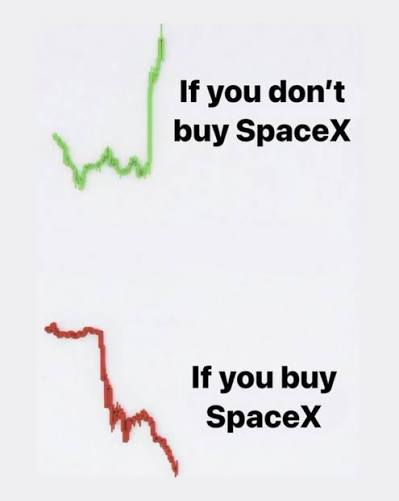
SpaceX followers since the IPO launch... 📉🚀
That's it for today's Slate.
Heart of earnings season. Stay sharp.
Today's reply prompt: Alphabet reports Wednesday. What is the one number from the earnings call that you think will move markets most?


