


Good morning, Slaters!
Tonight, the most expensive IPO in history will open its books for the first time.
SpaceX (SPCX) reports Q2 2026 earnings after the close, its first earnings release as a public company. The stock is down more than 50% from its post-listing peak. A $116 billion insider lockup begins unwinding on Wednesday. Wall Street wants answers. Elon Musk's management team has never had to provide them publicly before.
Advanced Micro Devices (AMD) reports alongside it. The Street expects $11.3 billion in revenue. AMD has rallied 125% this year on its AI rack platform and deepening Anthropic partnership. The question is whether the guidance opens the next leg or gives investors a reason to take profits.
Meanwhile, Monday happened. The S&P 500 gained 1.48%. The Dow hit a record 53,178. Amazon crossed $3 trillion. Oil plunged 5% after Trump called off an Iran strike. Palantir posted 93% revenue growth. And Japan confirmed the first coordinated yen intervention with the US since 2011.
Let's unpack what landed and what's still in the air.
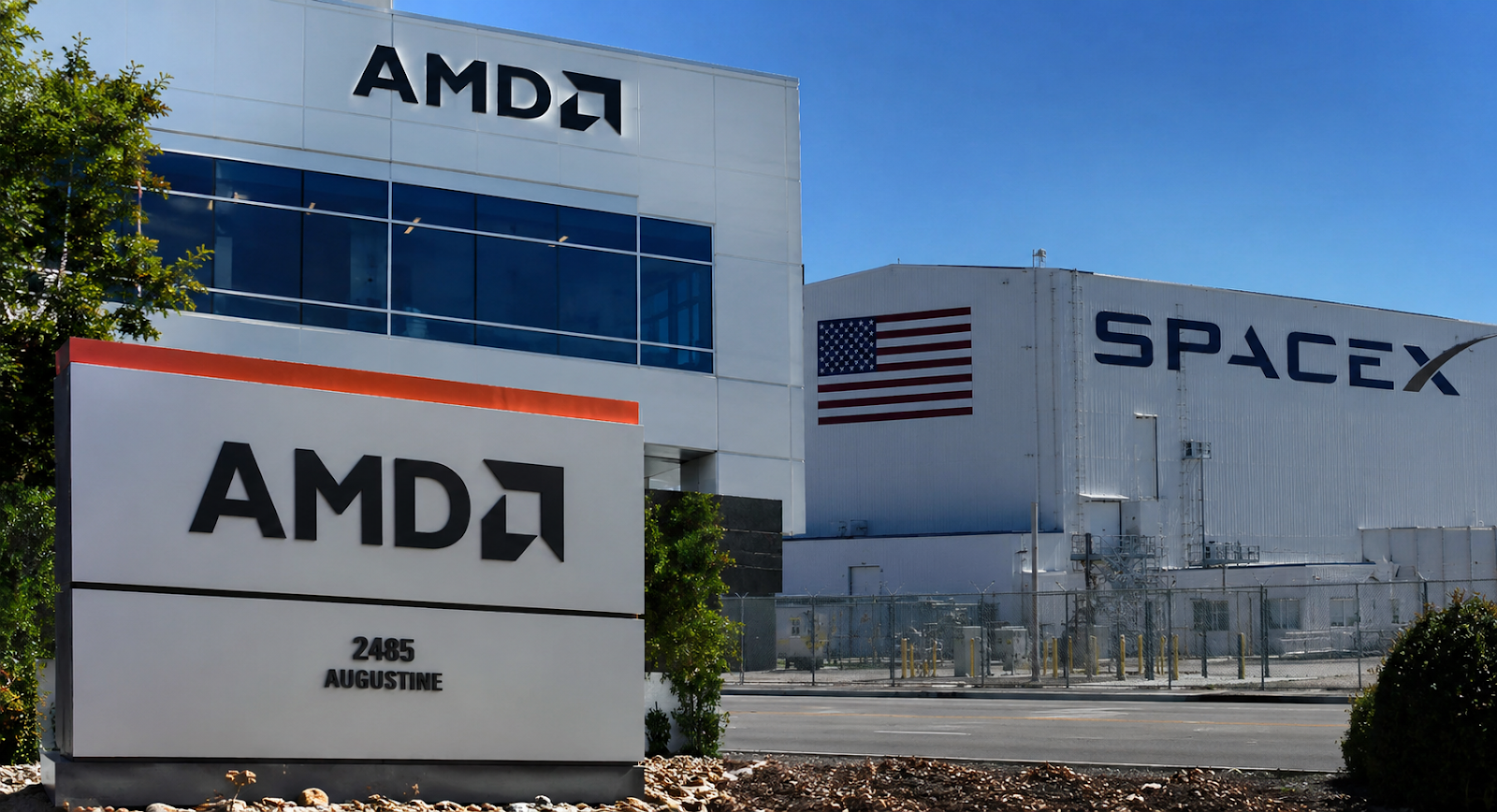
SpaceX opens its books tonight, and $116 billion is watching
SpaceX has existed as a private company for more than two decades. Tonight at 4:30 PM ET, that changes permanently. The company releases Q2 2026 results after the close, its first earnings report since listing on June 12 at $135 per share in an $85.7 billion IPO.
The known numbers are uncomfortable. SpaceX posted a $4.28 billion loss in Q1 2026 on $4.69 billion in revenue. The stock hit $225.64 five days after listing. It closed Monday around $113, down more than 50% and below IPO price.
Wall Street consensus for Q2: $6.88 billion in revenue. Morgan Stanley has maintained an Overweight rating and $300 price target, betting on long-term enterprise AI growth via the xAI merger.
But the real event is the lockup. Tonight's earnings release triggers an unlock allowing insiders to sell up to 20% of their restricted holdings, roughly 911.5 million shares, starting August 6. That is $116 billion of stock becoming eligible for the open market, the largest lockup expiration in financial history.
Management will address all three segments: Space (launch), Connectivity (Starlink), and AI infrastructure (xAI). Starlink had 10.3 million subscribers as of March 31, up 105% year over year. Q2 subscriber growth and margin data will tell investors whether the service justifies a stock still at 49 times expected revenue.
The market signal?
Strong revenue above $6.88 billion with credible forward guidance could stabilise the stock before the lockup flood Wednesday. A miss creates one of the most asymmetric single-stock risk events of 2026.
The 7 Stocks Built to Outlast the Market
Some stocks are built for a quarter… others for a lifetime.
Our 7 Stocks to Buy and Hold Forever report reveals companies with the strength to deliver year after year - through recessions, rate hikes, and even the next crash.
One is a tech leader with a 15% payout ratio - leaving decades of room for dividend growth.
Another is a utility that’s paid every quarter for 96 years straight.
And that’s not all - we’ve included 5 more companies that treat payouts as high priority.
These are the stocks that anchor portfolios and keep paying.
This is your chance to see all 7 names and tickers - from a consumer staples powerhouse with 20 years of outperformance to a healthcare leader with 61 years of payout hikes.
The report is free for a limited time - go here to get it now.
Monday's rally was powered by oil, tech, and a record Dow
The session told a clean story. Oil down, tech up, records broken.
The S&P 500 rose 1.48%. The Nasdaq surged 2.13%. The Dow gained 693 points to a record 53,178. Mega-cap tech led: Amazon (AMZN) soared 4.6% to cross $3 trillion in market cap for the first time. Microsoft (MSFT) gained 4.9%. Meta Platforms (META) jumped 6%.
The catalyst underneath: oil. Brent crude dropped 4.7% to $83.7. WTI fell 5% to $80.3. Trump called off a planned Iran strike over the weekend, posting on Truth Social that the "perimeters of a deal" had been agreed to. Iran denied any talks were planned. Falling oil lowers inflation expectations, loosens yields, and reprices growth stocks higher. That chain played out in one session.
S&P 500 blended Q2 earnings growth now tracks at 47.4%, per FactSet, the highest year-over-year rate since Q2 2021. With 61% of S&P 500 companies reported, 86% are beating on EPS. Even excluding Alphabet and Amazon's outsized GAAP surprises, the blended rate would be 28.8%, still the seventh consecutive quarter of double-digit growth.
The market signal?
The earnings spine is doing real structural work. The risk is oil reversing if Iran talks stall. Watch Brent above or below $85 as the tripwire for sentiment this week.
Palantir just posted the quarter that rewrites the comparison set
Alex Karp does not do subtle earnings calls. Monday was no exception. "Forget consensus," the Palantir Technologies (PLTR) CEO told CNBC. "To my knowledge, no business at our scale has even grown at this rate."
The numbers: Q2 revenue $1.94 billion, up 93% year over year, beating the $1.80 billion consensus. Adjusted EPS: $0.41 versus $0.35 expected. GAAP operating margin: 47%. Rule of 40 score: 155%.
The US commercial business was the engine. Revenue surged 149% year over year to $764 million. Remaining US commercial deal value more than doubled to $6.24 billion. The company raised full-year 2026 revenue guidance to $8.15 billion to $8.16 billion, up from $7.65 billion, representing 82% year-over-year growth. Q3 guidance of $2.16 billion sits above consensus. Adjusted free cash flow for the full year: $4.5 to $4.7 billion.
Shares jumped 12% after hours. The "too expensive" argument gets harder to sustain when revenue is doubling at a $2 billion quarterly run rate with 62% adjusted operating margins.
The market signal?
When your US commercial revenue triples in two years and your margins run above 60%, you are not a SaaS company. You are an infrastructure layer. The question is whether these multiples can sustain a re-rating or whether the first quarter of deceleration triggers a savage correction. For now, Karp has bought himself another quarter of runway.
"A Dangerous Financial Plan Unfolding in D.C. Could Cost You 40% of Your Wealth"

Former Goldman Sachs executive who traded through Black Monday warns this plan is all written down in black and white, spearheaded by a financial insider who infiltrated the Federal Reserve... It's gone "viral" in the hedge fund circles… and yet practically nobody on Main Street understands this financial shock playing out across America. He lays out all the evidence... plus a detailed roadmap for exactly what to do. (And it doesn't require shorting... options... or perfectly "timing the market.")
You must see this critical market briefing today.
This ad is sent on behalf of Stansberry Research, 1125 N Charles St, Baltimore, MD 21201. If you would like to optout from receiving offers from Stansberry Research please click here.
The US and Japan just did something they haven't done since 2011
On Friday, the United States and Japan conducted a coordinated yen-buying intervention, the first joint currency operation between the two countries since 2011. Japan's Finance Ministry confirmed it on Monday.
The yen had fallen to roughly 164 against the dollar last week, its weakest in nearly 40 years. After the intervention, it strengthened to around 157. Bank of Japan data suggests Tokyo spent as much as $36.58 billion buying yen on Friday. Treasury Secretary Scott Bessent confirmed the action and said Washington "will not hesitate to participate in further joint intervention."
Why does the US care? When Japan intervenes solo, it sells US Treasuries for dollars, pushing US long-term yields higher. The coordinated approach lets Japan access the Fed's FIMA repo facility without dumping Treasuries.
The market signal?
This is a bond-market story dressed as a currency story. If the yen stabilises near 157, it removes upward pressure on US long-term yields. If it weakens again, the 30-year Treasury becomes the thing to watch.
Peter Parker just broke a 7-year box office record
This one is not about earnings or rates. It is about a fictional teenager from Queens swinging through a $360 million opening weekend.
"Spider-Man: Brand New Day" opened to $360 million domestically over the weekend, beating "Avengers: Endgame's" 2019 record of $357.1 million to become the biggest domestic debut in box office history. Globally: $927 million in three days. It did this without IMAX screens, which remain locked up by Christopher Nolan's "The Odyssey."
The total US box office hit a record $429 million across all films. Year-to-date domestic grosses have crossed $6.1 billion, tracking ahead of pre-pandemic 2019.
For investors, the trade is Sony Group (SONY), which distributes Spider-Man, and AMC Entertainment (AMC), up 49% in the past month on a blockbuster summer slate. The larger signal is that physical entertainment is experiencing a genuine recovery cycle driven by franchise IP that streaming cannot replicate.
The market signal?
If "Brand New Day" legs toward $2 billion globally (only seven films have ever done it), it validates franchise-driven theatrical releases as a viable, high-margin business. Theater operators, concession suppliers, and studio stocks all benefit from that math.
I Became a Millionaire Here While I Was Still in College

This little-known building in Pasadena is where I learned about a kind of investment most people never get access to. Twenty years later, that same opportunity is wide open again. And it's all because of what's about to happen to OpenAI and Anthropic.
This ad is sent on behalf of InvestorPlace Media at 1125 N. Charles Street, Baltimore, Maryland 21201. If you're not interested in this opportunity, please click here.
- AMD reports Q2 after the close tonight alongside SpaceX. Wall Street expects $11.3 billion in revenue and $1.61 in adjusted EPS, representing 47% year-over-year growth. The real test is Q3 guidance: whether the Helios rack platform and MI350 GPU ramp justify a stock at 53 times forward earnings after rallying 125% this year.
- Caterpillar (CAT) reports before the bell. Consensus: $6.25 EPS on $19.3 billion in revenue. The equipment maker sits on a record $63 billion backlog. This is the print that tells you whether the industrial economy is keeping pace with the AI buildout.
- Alibaba (BABA) unveiled Qwen3.8-Max on Monday, a 2.4-trillion-parameter AI model that it claims rivals Anthropic's Fable 5. The weights go open-source next week. Hong Kong-listed shares jumped 7%. The Chinese AI race just produced its second frontier-class model in a month, both open-sourced, putting structural pricing pressure on Western model providers.
- The market signal across all three?
- SpaceX tells you whether the biggest IPO of the decade was priced right. AMD tells you whether the AI hardware cycle has another leg. Caterpillar tells you whether anything outside tech is still growing.

That's it for today's Slate. Massive after-hours session tonight. Stay close.
Today's reply prompt: SpaceX or AMD: which after-hours print matters more for your portfolio tonight?


