


Good morning, Slaters!
Yesterday was a split-screen day so extreme it almost felt scripted.
On one side: oil crossed $100 a barrel for the first time in two months after Iran-backed Houthis hit two Saudi tankers in the Red Sea. The Nasdaq dropped 2.1%, its worst session in a month. Alphabet and Tesla, fresh off earnings, dragged megacap tech to its ugliest day since the April 2025 tariff rout. The 10-year Treasury yield touched 4.67%, a 52-week high.
On the other side: Intel, after the close, reported its best quarter in 15 years. Revenue up 25%. Data centre sales up 59%. The stock jumped 12% after hours. And the entire semiconductor complex is about to reprice this morning.
So one part of the market is screaming inflation risk. The other part is screaming AI-fuelled growth. Both sides have real data behind them. That tension is the story of the summer.
Let's get into it.
Intel just posted its best quarter since 2011
Here is the number that made analysts stop mid-sentence: $16.1 billion.
That is Intel's (INTC) Q2 revenue, announced after Thursday's close. Wall Street expected $14.4 billion. Intel beat it by $1.7 billion, or roughly 12%. Adjusted EPS came in at $0.38 against a consensus of $0.21. Revenue grew 25% year-over-year, the fastest clip the company has posted since 2011.
The data centre and AI segment led the charge at $6.3 billion versus estimates of $5.54 billion, a 59% surge. Q3 guidance of $15.8 billion to $16.8 billion cleared the $15.06 billion consensus by a wide margin. Intel also raised its 2026 capex plan to $20 billion and confirmed its 18A process node is now yielding 85%, up from 65%, with its first external cloud customer order secured.
Intel's stock has gained 170% year-to-date but had fallen 28% in July alone during a sector rotation. The 12% after-hours pop suggests the beat was large enough to break the selling pattern.
The market signal?
If Intel can grow data centre revenue 59% while Alphabet and Tesla are getting punished for spending too much on AI infrastructure, it means the demand side of the AI buildout is accelerating faster than investor anxiety about capex. Watch the semiconductor complex at today's open. The signal from Intel is that AI spending is producing results, not just invoices.
Wall Street's Favorite AI Stocks Are Walking Into a MASSACRE
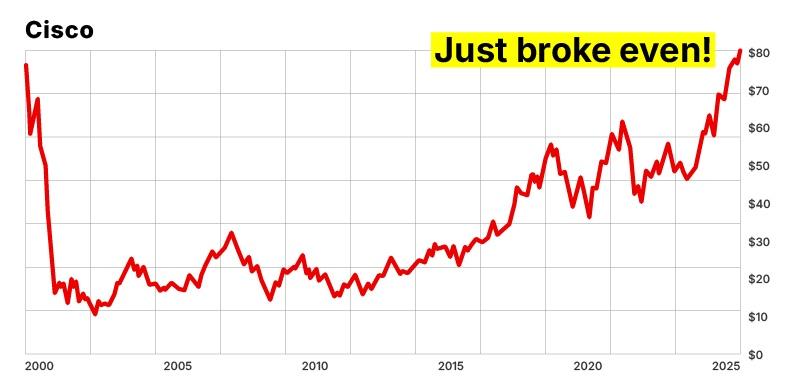
Cisco was once the MOST valuable company on Earth. Then it fell 80% - and investors waited 25 YEARS just to break even.
A Wall Street legend is out with a new warning: "It's about to happen again." He says many of today's overhyped AI darlings - stocks sitting in almost every 401(k) in America - could lose up to HALF their value or more.
He just went on camera with the names.
Oil at $100. The conflict just widened.
Brent crude closed at $100.69 a barrel on Thursday, up 7%. WTI settled at $92.19. Both touched their highest levels in two months.
The trigger: Houthi rebels struck two Saudi oil tankers in the Red Sea with drones and missiles. The Encelia caught fire. Five more Saudi tankers reversed course. The Houthis had declared a maritime blockade on Saudi ports this week, and Thursday was the first enforcement of it.
The Strait of Hormuz has been blocked since February. The Bab al-Mandeb Strait is now contested too. Two of the world's three most critical oil chokepoints are under simultaneous threat. Goldman Sachs warned Brent could exceed $120 by Q4 if disruptions persist.
Trump told Axios he is "considering a massive attack" on Iran. US strikes on Iran continued for a 13th consecutive night.
The market signal?
Every dollar oil gains from here feeds directly into inflation expectations and narrows the Fed's room to cut. The Fed decision arrives next Wednesday. Oil at $100 with a widening conflict is the last thing the FOMC wanted to see on its desk going into that meeting.
Alphabet fell 7%. Tesla fell 14%. Both beat on revenue.
Both beat on revenue. Both delivered negative free cash flow. Both got sold.
Alphabet (GOOGL) fell 7%. Revenue hit $119.8 billion. Google Cloud surged 82%. But Alphabet raised its 2026 capex guidance to $195 billion to $205 billion, and that scared investors more than the revenue beat impressed them.
Tesla (TSLA) fell 14%. Revenue of $28.2 billion beat estimates, but EPS of $0.33 missed the $0.54 consensus by 39%. Operating income fell 57%. Free cash flow turned negative as AI and robotics spending outran automotive margins.
Together, these two companies represent $3.3 trillion of market cap. Their combined message: AI spending is not optional. And it is not slowing.
The market signal?
Companies that can show revenue from AI investments (Intel, ServiceNow) are being rewarded. Companies still in "trust us" mode on returns are being taxed. That sorting defines the rest of earnings season.
Could This Stock Be “Trump’s Next Big Buy”?
Jim Rickards believes the Trump administration is about to take a direct stake in a tiny $2 stock.
The Trump administration has taken a direct stake in MP Materials, Lithium America, Trilogy Metals, and USA Rare Earth.
Each time, shares sprinted higher. Click here to see why Jim believes this one is next.
Reddit just exposed the real cost of training AI
This is not a standard tech-stock story. This is about who actually pays for the data that makes AI work.
Reddit (RDDT) fell 9% on Tuesday after the Wall Street Journal reported the company is reconsidering its $60 million-a-year AI content licensing deal with Google.
The reason? Google's AI Overviews, the summaries that appear above search results, have been cannibalising referral traffic to Reddit. The deal pays Reddit for its data, but the product built on that data is sending fewer readers back to the platform.
Reddit is not alone. Over the past year, USA Today's Google search traffic fell roughly 50%. CNN lost 25%. Business Insider lost more than 85%. AI-generated answers are replacing the links that used to send readers to the source.
The arithmetic is uncomfortable. AI companies need training data. Content platforms produce it. But once the model has learned, it bypasses the source. The publisher gets paid once. The model profits indefinitely. Reddit may be the first major platform to draw the line.
The market signal?
If Reddit walks away, it loses $60 million a year. If it stays, it accelerates the erosion of its own traffic moat. AI licensing revenue is starting to look less like upside and more like a Faustian bargain.
Buffett, Gates and Bezos Quietly Dumping Stocks—Here's Why
The world's wealthiest individuals are making huge moves with their money.
Warren Buffett just liquidated billions of shares. Bill Gates sold 500,000 shares of Microsoft. Jeff Bezos filed to sell Amazon shares worth $4.8 billion.
What is going on? One multi-millionaire believes they are preparing for a catastrophic event. But not a crash, bank run, or recession. It’s something we haven’t seen in America for more than a century.
- American Express (AXP) and Verizon (VZ) report Q2 results before this morning's bell. AmEx is the consumer-spending bellwether: analysts expect $4.40 EPS on $19.7 billion in revenue, both up about 9%. With the savings rate at 2.6%, watch credit loss rates for early stress signals.
- The ECB held rates at 2.25% on Thursday, as expected, but the language was hawkish. Lagarde called the energy outlook "highly volatile." The ECB remains the only major Western central bank to have hiked this cycle. The Fed announces next Wednesday with 89% odds of no change.
- New home sales data for June drops at 10 AM ET. May's print was 580,000 units annualised, down 7.3% from April. With the 10-year yield at 4.67%, affordability remains the binding constraint.
- The market signal across all three?
- The consumer is being stress-tested from every angle: credit spending, borrowing costs, and energy prices. If all three tell the same story, the second-half narrative gets harder for the bulls.

That's it for today's Slate.
Big morning. Intel repricing, oil at $100, AmEx and Verizon on deck.
Stay close to the signals.
Today's reply prompt: Intel up 12% after hours. Oil at $100. Which of these two numbers matters more for your portfolio this morning?


