Good morning, Slaters!A week ago, the Federal Reserve raised rates for the first time since 2023. Chair Warsh called it a "recalibration." The bond market barely flinched. And then the Nasdaq went and hit an all-time high. That is a sentence that should not work. A rate hike is supposed to cool things down. Instead, chip stocks surged. Advanced Micro Devices (AMD) crossed $1 trillion in market cap for the first time ever. Intel (INTC) jumped 12% in a single session. Brent crude dropped below $100 on fresh signals that Iran could reopen the Strait of Hormuz within seven days. And President Trump, addressing the UN General Assembly on Tuesday, said he had a "big decision" to make: negotiate with Iran or "annihilate" the Islamic Republic. The market heard "deal" and kept buying. So this is where September stands. A Fed that just tightened. A tech sector that refuses to care. An oil market quietly repricing toward peace. And a Trump-Xi summit arriving tomorrow in Washington that could reshape the AI trade, the rare-earths supply chain, and the next round of export controls in a single afternoon. The tension is real. But so is the momentum. Let's get into what's driving it. 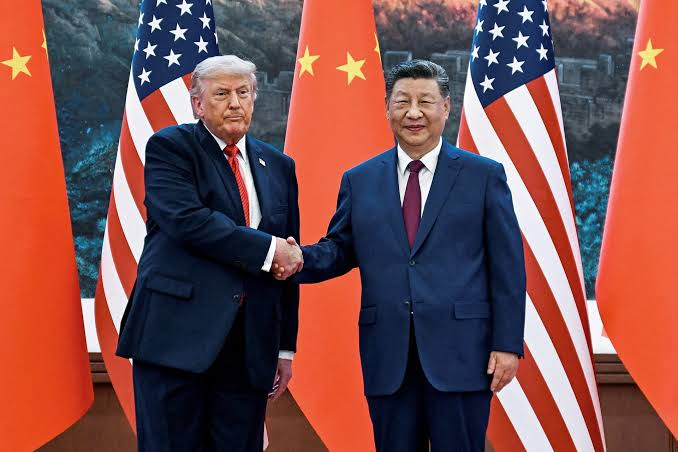
Daybreak AMD is the fourth chipmaker to cross $1 trillion. The race above it is just starting.Let's start with the number: $615.52. That was AMD's intraday high on Monday, the price that tipped its market capitalisation past the $1 trillion mark for the first time in its history. The stock finished up roughly 10% on the day, capping a five-session rally of 25%. For the year, AMD is up more than 180%. AMD now joins Nvidia (NVDA), Broadcom (AVGO), and Micron (MU) as the fourth US chipmaker to hold a trillion-dollar valuation. Five years ago, zero semiconductor companies were in the club. The entire trillion-dollar tier was reserved for consumer platforms and cloud giants. The fuel is data centres. AMD's Q2 2026 data centre revenue hit $6.7 billion, up 107% year-over-year. CEO Lisa Su has targeted doubling that figure again by 2027. Analysts project AMD could hold 20-25% of the AI accelerator market by late this year, up from roughly 13% at the start of 2026. But the more telling comparison is upward, not backward. Nvidia sits at roughly $5.4 trillion. AMD's 2026 stock gain of 180% dwarfs Nvidia's roughly 3%. The market is pricing AMD's future share gains, not its current slice of the pie. The market signal? Four trillion-dollar chipmakers now exist in the same economy that had none three years ago. That is not a bubble verdict. It is a capex verdict. The companies building AI infrastructure are spending faster than any corporate category in history, and every one of those dollars flows through a silicon supply chain that has more demand than capacity. The correction risk is real. The structural demand is also real. Both things coexist. PREMIER FEATURE I've Read a Lot of Mining Filings. They All Sound the Same.This one stopped me cold. Sitting in the filings of one small American gold company is a phrase I have never seen on a gold project: substantial support and partnership from the Department of War. The Department of War does not partner with gold miners. Except it's partnering with this one. Here's why. The deposit carries a second metal — one China formally banned from export to the United States. The only domestic reserve of it in the country. Gold for the dollar war. The banned metal for the shooting war. Both from the same pit. Washington didn't stop at words. On May 21, 2026, a federal bank voted unanimously to lend nearly $3 billion to build it. Congress got 25 days notice. Nobody objected. When final papers are signed, funding risk goes to zero — and Wall Street re-rates the stock from speculative developer to federally backed strategic asset. The company is about one fiftieth the size of Newmont. Read the filing for yourself Pulse Check The Nasdaq erased four months of pain in two sessionsOn Tuesday, the Nasdaq Composite closed at 27,244, its second consecutive record. The prior all-time high of 27,190, set on June 1, had stood untouched for nearly four months through a rate hike, an oil shock, and a geopolitical crisis that closed the Strait of Hormuz. The index erased all of that in two trading sessions. The S&P 500 finished flat at roughly 7,764. The Dow Jones fell 185 points, dragged lower by Cisco Systems (CSCO), JPMorgan (JPM), and American Express (AXP). The divergence is worth noting: tech-heavy indexes are leading, while financials and industrials are lagging. That tells you this is an AI-driven move, not a broad cyclical recovery. Treasury yields eased on Tuesday. The 10-year slipped to roughly 4.95%, down from its September high near 4.97%. The 30-year sat at 5.29%. Falling oil helped. Brent crude dropped to around $98.40 per barrel, its fifth consecutive session of declines, after Iran signalled willingness to reopen Hormuz within a week if the US eases its blockade. The market signal? The Nasdaq's record close is built on a very specific foundation: chip stocks plus falling oil. If either leg breaks, the record is exposed. Flash PMI data at 9:45 a.m. this morning will test the first leg. Iran diplomacy tests the second, hour by hour. Who Moved the Mic? Trump told the UN he'd annihilate Iran, then said he thinks they'll make a dealTuesday's most consequential words came from a podium at the United Nations General Assembly. President Trump told world leaders he faced a "big decision" on Iran: either negotiate a deal to end the war, or "annihilate" the Islamic Republic. Then he softened. He said he believed a deal would come together after the November midterm elections. He noted that more oil is flowing now than at any point since the war began and predicted prices would "drop like a rock" once the conflict ends. Markets parsed the statement with surgical precision. Oil fell. Equities held. The reading: the threat was theatre, the deal prediction was signal. Simultaneously, Japan's Kyodo News Agency reported that Iran has offered to reopen the Strait of Hormuz within seven days if the US takes steps toward lifting its blockade. Saudi Arabia is reportedly preparing to restart its East-West pipeline, with flows potentially resuming by this weekend. Neither report has been independently verified by US officials. Secretary of State Marco Rubio said he was unaware of plans for a Trump-Pezeshkian meeting. The market signal? Every cent oil drops is a cent off the inflation forecast. Brent below $95 would materially improve the Fed's Q4 calculus. But the market is now priced for a deal that still has no signatures. If diplomacy stalls through the midterms, as Trump himself suggested, oil has room to snap back. This is a headline-driven trade, and today is full of headlines. FROM OUR SPONSORS The REAL Reason Trump Is Invading Iran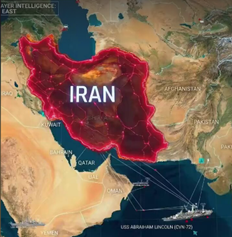
For a moment… Forget about Trump’s ties to Israel. Forget about reports of Iran’s nuclear program. Because my research has led me to believe we’re risking World War 3 with Iran for a completely different reason. Click here to find out what it is. If you have even a single dollar invested in the U.S. stock market, this is going to directly impact you. Discover the reason here. Beyond the Candles The US government is sitting on a $44 billion gain from a single stockHere is a trade that would make any hedge fund blush. In August 2025, the US government purchased 433.3 million shares of Intel at $20.47 apiece, a total outlay of $8.9 billion funded through CHIPS Act grants and the Secure Enclave program. The stake equalled roughly 9.9% of Intel's outstanding shares. After Monday's 12% surge, Intel closed at $121.78. That 433-million-share block is now worth approximately $52.8 billion. The unrealized gain: roughly $43.9 billion, or a 495% return in thirteen months. Intel's rally is not a single-catalyst story. The foundry strategy is gaining traction. Data centre revenue grew 59% in the first half of 2026, adding $1.8 billion in operating income. The broader chip rally, which saw Arm Holdings (ARM) jump 15% and the Philadelphia Semiconductor Index hit a one-month high on Monday, lifted every name in the sector. But the government angle adds a layer most investors are not tracking. Washington is no longer just subsidising chip production. It is profiting from it. The CHIPS Act has evolved from an industrial policy into an investment vehicle, and one of the most successful single-stock bets in the history of federal spending. The market signal? When the government owns 9.9% of a stock at a $44 billion gain, the question of when and how it exits becomes material. Any signal of a sale would create meaningful supply. No signal has come. But the position is now large enough that it cannot be unwound quietly. Under the Hood Three earnings reports this morning tell you three different things about AmericaBefore the bell today, three companies report. Together, they form a triptych of the American economy that no single data release can replicate. Paychex (PAYX) processes payroll for roughly 740,000 small and mid-sized businesses. Consensus expects $1.32 EPS on $1.63 billion in revenue. Its client-level employment data is one of the most granular real-time reads on whether small-business hiring is holding or bending under the weight of a 4% fed funds rate. In a week with no major jobs report, Paychex is the proxy. Cintas (CTAS) supplies uniforms, facility services, and safety equipment to businesses across every sector. Consensus: $1.36 EPS on $2.98 billion revenue. The company pre-announced a 15.6% dividend increase to $2.08 annualised, which tells you management sees durable cash flow ahead. Cintas's revenue trajectory is a parallel read on whether corporate America is still investing in physical operations or starting to pull back. General Mills (GIS) sits on the other end of the income spectrum. The packaged-foods company reports into a consumer environment where grocery inflation has barely eased and private-label brands are eating into volume. Consensus: $0.72 EPS on $4.35 billion revenue. This is a company whose results tell you what the household budget looks like after the rent and the car payment. The market signal? If Paychex's client employment data shows softening and General Mills posts volume declines, the "vibepression" narrative from earlier this year gets a fresh chapter. If Cintas beats, corporate-services demand is intact. Watch the trifecta together. The pattern matters more than any single print. What's Brewing - The September flash PMI lands at 9:45 a.m. from S&P Global. August's composite reading came in at 56.0, a 53-month high. Manufacturing has run at 53.9 for three straight months. A reading above 55 composite would give the bulls more ammunition. But the prices-paid subindex is the one the Fed watches. If input costs reaccelerate despite falling oil, the September hike odds rise.
- Tomorrow's Trump-Xi summit in Washington is the week's centrepiece. Trade, AI safeguards, rare-earth export controls, and Taiwan are all on the table. The Diplomat reports that the US and China have floated an AI-risk "hotline." Jensen Huang and Elon Musk are reportedly attending alongside the delegations. Any concrete language on semiconductor export policy could move NVDA, AMD, and INTC in either direction by Thursday morning.
- Thursday also brings Costco (COST) and Darden Restaurants (DRI) earnings, the next consumer-health datapoints after today's General Mills. Costco's membership renewal rate and Darden's same-store traffic will tell you whether the American consumer is coping or cracking heading into Q4.
- The market signal across all three? This is a 48-hour stretch that tests every pillar holding the rally: the AI trade (PMI, earnings), the oil trade (Iran signals), and the geopolitical trade (Trump-Xi). Position accordingly.
Meme of the Day 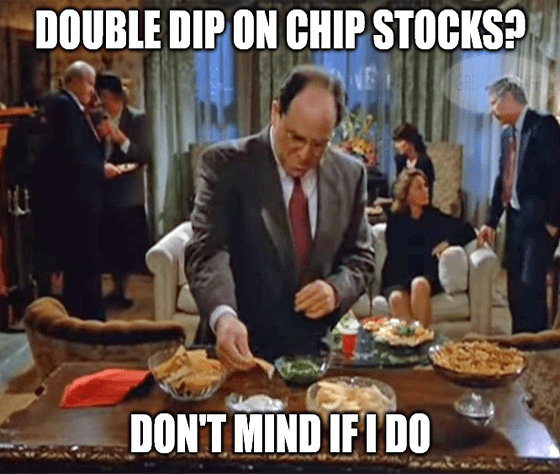
That's it for today's Slate. Flash PMI at 9:45. Three earnings before the bell. Trump-Xi tomorrow. Stay close to the feed. Today's reply prompt: The government turned $8.9 billion into $52.8 billion on Intel. Should it sell? 3 STOCKS OUR SIGNAL ENGINE SAYS TO WATCH CAREFULLY Three stocks. Three signals. Two weeks later, the story changed.On September 2, we published three market questions around KLAC, HPE and PG&E.
Two weeks later, every one of them produced new evidence. One company delivered record revenue and raised its outlook.
Another saw weakness spread across its entire peer group.
And in the third, a market risk that had only been showing up beneath the surface suddenly became explicit.
Yet none of these stories is finished. That’s why we built Market Tell.
To track the signals that keep moving after the headline is gone — and show you what investors should be watching next. We’ve put the latest analysis into a new FREE Special Report:
3 Stocks at a Major Turning Point See what changed… what still hasn’t been resolved… and the signals we’re watching now. Get the Free Report → |