Good morning, Slaters!The Federal Reserve just did something it hasn't done in three years. It raised interest rates. Not because the economy is collapsing. Not because unemployment is spiking. Because inflation, in Kevin Warsh's own words, "has been too high for too long." The 25 basis point hike to 3.75%-4% was unanimous, 12-0, which tells you the debate inside the building had already been settled before the vote was taken. The dot plot tells the rest of the story: 16 of 18 participants expect at least one more hike this year. But here is the strange part. On the same morning the Fed moved to tighten financial conditions, August retail sales came in at +1.2%, nearly double the forecast. Control group sales jumped 1.4%, the strongest reading since early 2025. Consumers are spending as if nobody told them rates are going up. And then, after the close, Lennar (LEN) reported Q3 earnings that missed on both revenue and EPS, cut delivery guidance, and showed new orders falling 9% year over year. The homebuilder's results are what happens when rate policy meets the real economy at the front door. Literally. Three data points, one day. Consumer spending running hot. A central bank stepping on the brakes. And a housing sector already feeling the tread marks. The next few weeks will tell us which of these stories is the outlier. 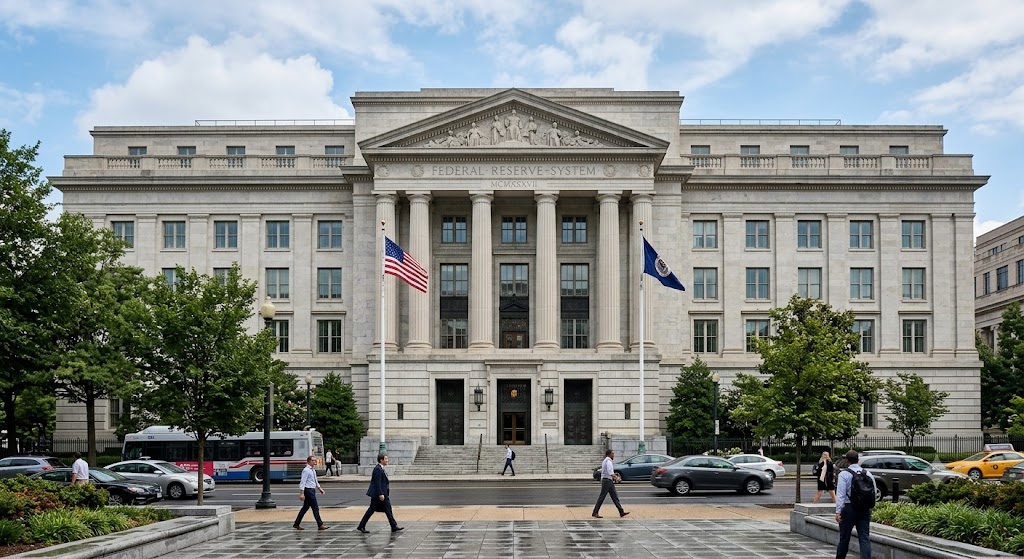
Daybreak Warsh's first hike: unanimous, hawkish, and deliberately vague about what comes nextKevin Warsh has been Fed chair for 118 days. For most of them, he has said almost nothing of substance about where rates are headed. On Wednesday, at 2:30 p.m. ET, he said everything he needed to in about 30 minutes. The FOMC raised the federal funds rate by 25 basis points to a target range of 3.75% to 4%. The vote was 12-0. In July, three members had dissented in favor of a hike, but the committee held. This time, Warsh brought everyone along. The updated Summary of Economic Projections filled in the rest. PCE inflation is now projected at 3.7% for 2026, falling to 2.3% in 2027. The dot plot showed 16 of 18 participants expecting another hike this year, with four penciling in two more. Warsh himself, following precedent, did not submit a dot. His press conference kept the same tone: purposefully opaque on timing, crystal clear on direction. "What is clear is that inflation is too high and has lasted too long," he said. He added that he would be "hard-pressed to describe broad financial conditions as restrictive." That last line is the one the bond market will chew on. If the Fed chair does not view conditions as restrictive at 3.75%-4%, higher is the direction of travel. The market signal? The 10-year Treasury yield pulled back nearly 5 basis points to around 4.95% after the decision, a sigh of relief from a bond market that briefly touched 5.04% on Tuesday. But futures are already pricing in roughly a 4.1% effective rate by December. One more hike is baseline. The question is December or earlier. PREMIER FEATURE Rumors are spreading quickly... Elon is gearing up to buy a tiny, publicly traded company. Why? Because it holds the exclusive rights to a $16 trillion MOTHERLODE of the exact materials his empire runs on... rare metals like cobalt, manganese and lithium. On January 1st, a new Pentagon rule cuts off his Chinese supply. Today, it's a $5 stock... but once Elon makes his move, it could soar to $50 within 6 months. Click here for the full story. Pulse Check The day the market heard the hike and shruggedWednesday's close told two stories depending on which ticker you watched. The Dow Jones Industrial Average dropped 631 points, or 1.21%, to close at 51,461. Goldman Sachs (GS) led the losses at -3.92%. The entire bank sector fell hard. The State Street SPDR S&P Bank ETF (KBE) dropped 2.6%, its worst session since February. JPMorgan Chase (JPM) fell 1.5%. Wells Fargo (WFC), Bank of America (BAC), and Citigroup (C) all dropped more than 3%. The S&P 500 fell 0.45% to 7,551. But the Nasdaq Composite barely flinched, slipping just 0.01% to 25,978. All three indexes had been higher earlier in the session before the decision landed. Thursday pre-market tells a different story. Dow futures are up 0.2%. S&P 500 futures are up 0.3%. Nasdaq 100 futures are up 0.5%. The overnight read is that the hike was priced in, the unanimity removed tail risk, and the worst-case scenario of a surprise 50 basis point move never materialized. The market signal? The divergence between banks and tech on Wednesday is the trade to watch. Banks sell off on hikes because tighter policy compresses net interest margins and raises credit risk. Tech held up because AI demand operates on a different timeline than the rate cycle. If that split persists, the Nasdaq continues to outperform the Dow through year-end. Who Moved the Mic? The consumer who refuses to quitWhile the Fed was calibrating its rate decision, the Census Bureau released August retail sales at 8:30 a.m., and the number was hotter than anyone expected. Retail and food services sales rose 1.2% month over month to $773.9 billion, well above the 0.8% gain economists had forecast. The July decline was revised up from -0.6% to -0.5%. Year over year, sales were up 6.0%. The control group, which feeds directly into GDP calculations, surged 1.4%, its strongest print since early 2025. Gas station sales jumped 3.1%, reflecting pump prices. But even excluding gas, retail sales rose 1.1%. Back-to-school demand lifted general merchandise, clothing, and electronics. TD Economics noted that Q3 consumer spending is now tracking a robust 3% annualized, only a modest deceleration from Q2's 3.4%. This is the paradox the Fed is working against. The consumer is behaving like someone who will keep spending until something stops them. That "something" is exactly what Warsh is now trying to deliver. The market signal? Strong retail sales give the Fed cover for another hike. They also raise the Q3 GDP tracking estimate, which pushes against any recession narrative. For equity markets, consumer resilience is bullish for revenue but hawkish for the rate path. Both of those things cannot be true forever. FROM OUR SPONSORS Take a look at this… It's a radical "light-speed" device that's turning AI as we know it into "Accelerated AI", making it 100 times faster and 100 times more energy efficient. In fact, Jensen Huang, Nvidia's founder and CEO, says this device is shattering the limitations of AI and without it, AI can't scale. If you want to discover what this technology is, why Nvidia is betting billions on it… And the one stock we believe could be the biggest winner when "Accelerated AI" goes mainstream… Click here to see all the details. Beyond the Candles Lennar just told you what a rate hike feels like on the groundLennar Corporation (LEN) reported Q3 fiscal 2026 earnings after Wednesday's close, and the timing could not have been more symbolic. Hours after the Fed hiked rates for the first time in three years, the country's second-largest homebuilder told you exactly what that means for the people trying to buy a house. Revenue came in at $8.05 billion, below the $8.32 billion consensus. Adjusted EPS was $1.23 versus $1.30 expected. Homebuilding revenue fell 6% year over year on 3% fewer deliveries and a 3% lower average selling price of $372,000. Gross margin on home sales compressed to 15.8% from 17.5% a year ago. New orders declined 9% to 20,879 homes. Management cut full-year delivery guidance to 80,000-81,000 homes from 82,000-83,000. The mechanics are straightforward. Mortgage rates averaged 6.76% before the hike. Higher rates mean higher monthly payments, fewer qualified buyers, and more incentives to move inventory. Lennar is currently offering incentives worth roughly 14% of the home's sale price. That is margin being handed directly to the buyer. The earnings call at 11:00 a.m. ET Thursday will be closely watched for September order trends and whether the hike has already started to bite. The market signal? Homebuilder stocks are the most rate-sensitive corner of the equity market. Lennar's miss, coming on the same day as the Fed decision, is a clean real-time read on how tighter policy translates into lower demand. If the Fed follows through with another hike in December, the housing sector's margin compression accelerates from here. Under the Hood At Dreamforce, three AI CEOs disagreed about the future in front of 43,000 peopleWhile Washington was consumed by rate policy, San Francisco was hosting its own version of a power summit. Salesforce's (CRM) Dreamforce 2026 conference opened Tuesday and runs through Thursday, with about 43,000 attendees filling the Moscone Center. The headline product announcement: "AIforce," a rebranding that positions Salesforce's CRM as something that comes to the user, inside Slack, Claude, or Lightning, rather than a platform the user visits. But the real spectacle was the CEO panels. Anthropic's Dario Amodei, who had published an essay over the weekend urging the industry to slow model development, took the stage alongside Marc Benioff and told an audience of 12,000 that "everyone can always be better" on safety. OpenAI's Sam Altman appeared separately and covered regulation, competition, and the pace of capability gains. Nvidia's (NVDA) Jensen Huang offered a starkly different view, one that, as CNBC reported, diverged from both Amodei and Altman on questions of AI risk. Three companies building the infrastructure, the models, and the application layer of AI, and they cannot agree on how fast to run. That matters because regulation always follows disagreement. When the builders start arguing in public about pace and safety, the policymakers start writing rules. The market signal? Dreamforce's investor and analyst session ran Wednesday at 1 p.m. PT. Any updated financial framework from Salesforce, especially around Agentforce bookings or the monetization of AIforce, could move CRM in Thursday's session. The broader takeaway: the AI safety debate has moved from think tanks to the main stage of the industry's largest conference. That shifts the risk premium for the entire sector. SPONSOR SPOTLIGHT Buffett, Gates and Bezos Quietly Dumping Stocks—Here's Why 
The world's wealthiest individuals are making huge moves with their money. Warren Buffett just liquidated billions of shares. Bill Gates sold 500,000 shares of Microsoft. Jeff Bezos filed to sell Amazon shares worth $4.8 billion. What is going on? One multi-millionaire believes they are preparing for a catastrophic event. But not a crash, bank run, or recession. It’s something we haven’t seen in America for more than a century. For the full story, click here. What's Brewing - The Lennar earnings call at 11:00 a.m. ET Thursday will be the first management commentary on housing demand in a post-hike environment. Watch for September order commentary and any change in incentive strategy. If Lennar signals that the hike is already showing up in buyer behavior, the iShares U.S. Home Construction ETF (ITB) is the first place it trades.
- The Bank of Japan's rate decision arrives Friday. Japanese government bond yields hit a fresh 30-year high this week, and the BOJ faces mounting pressure to tighten. A surprise move would ripple through global bond markets that are already stretched, especially with 10-year US Treasuries just pulling back from 19-year highs.
- Oil continues to anchor every macro story. Brent crude was trading near $107.50 on Tuesday, a four-month high, after Saudi Arabia's East-West pipeline remains offline. Iran has signaled it will not negotiate until US conditions are met. Every dollar higher on Brent adds roughly 0.02% to the next PCE reading. The number that quietly drives everything else.
- The market signal across all three? The rate hike was Wednesday's headline. Thursday's question is how fast it travels into the real economy. Lennar's call, Japan's decision, and Brent's trajectory will each provide a different answer.
Meme of the Day 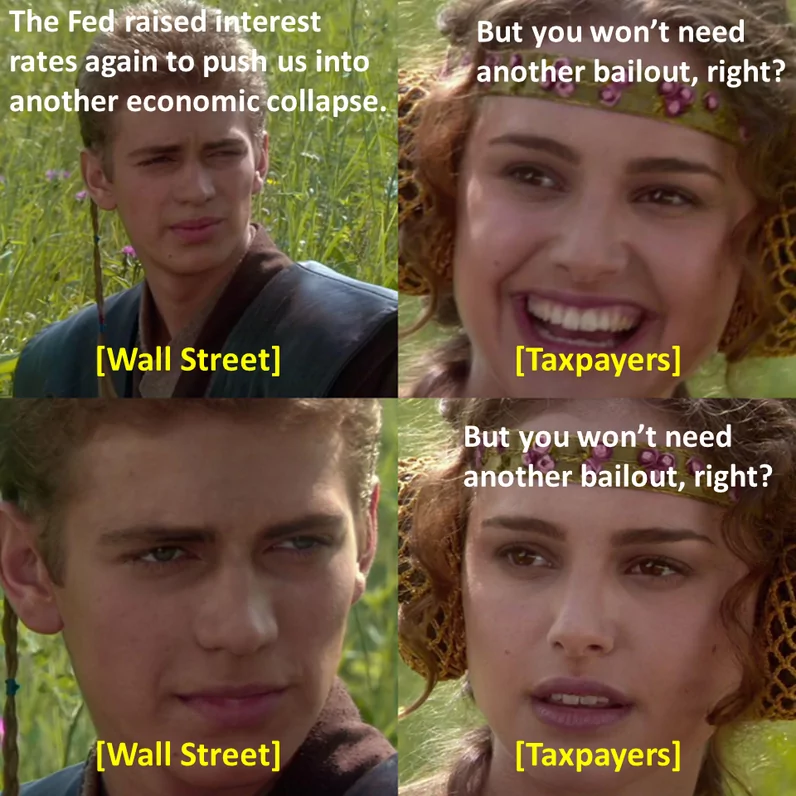
That's it for today's Slate. Big session ahead. Lennar call, Dreamforce day three, and the post-hike digestion begins. Stay close to the signals. Today's reply prompt: The Fed just hiked. Are you buying the dip, hedging the rate risk, or sitting this one out? THE MARKET WON’T WAIT FOR YOUR INBOX Get the Alerts That Could Move Your Money Breaking market news, actionable trade ideas, analyst signals, and major catalysts—sent straight to your phone when they matter. Join FinancialMarkets.com FREE market alert list today. SEND ME THE NEXT ALERT → (free) |