


Good morning, Slaters!
Every trade has a story it tells itself to justify the price. The AI chip trade has been telling this one: China cannot build the machines. The West controls the bottleneck. The moat is physics, not politics.
On Monday, a Shanghai company started shipping homegrown lithography machines to SMIC, Hua Hong, and CXMT. Five units this year. Twenty next year. Not cutting-edge by ASML's standards, but exactly the generation China needs for cars, phones, servers, and AI inference chips.
Seoul heard the story change and panicked. The KOSPI crashed 10.8% on Tuesday. Samsung fell 13%. SK Hynix fell 13.5%. ASML lost 6.5%. Nvidia (NVDA) dropped 5% on circular financing fears. Two cracks in the AI thesis landed on the same day.
Let's look at what actually changed.
The machine China was never supposed to build
A state-backed company in Shanghai, assembling teams from startup Yuliangsheng Technology, has begun mass-producing immersion DUV lithography machines. First units ship this year to SMIC, Hua Hong, and CXMT. Output targets: five systems in 2026, twenty in 2027.
ASML ships about 130 immersion DUV systems a year. Five Chinese units is 3.8% of that. These are not EUV machines, the frontier tech ASML monopolises. They are older DUV tools that print down to 7nm through multipatterning. But DUV is sufficient for the vast majority of chips the world uses. The entire US export control architecture assumed China could not build these domestically.
The sell chain was immediate. ASML fell 6.5%. Applied Materials (AMAT), Lam Research (LRCX), and KLA Corp (KLAC) all dropped roughly 7%. AMD fell 5%. Micron (MU) shed 2%.
Banks called the sell-off overdone. Five units is not a commercial threat. Some parts still come from Japan. But markets price what might be true in 2028. On that timeline, twenty units becomes fifty, and eventually it becomes a genuine alternative supply chain.
The market signal?
The chip equipment trade just acquired a new risk premium for domestic substitution that did not exist last week.
The Big AI Story Nobody Knows

There's a website called RentAHuman.ai. Its tagline: "Robots need your body."
721,000 people across 100 countries have signed up.
And according to Alexander Green - the man who bought Apple under $1, Netflix at $1.62, Amazon under $2* - this is the clearest signal yet that Phase 2 of the AI supercycle has arrived. (Split adjusted prices)
He's identified three companies set to dominate this next phase.
Seoul's worst day since March, in numbers
The KOSPI closed at 6,023 on Tuesday, down 732 points, or 10.8%. Fourth-largest percentage decline in the index's history. The KOSDAQ fell 7.7%. A circuit breaker halted trading for twenty minutes. The index briefly dipped below 6,000.
Samsung Electronics sank 13.1%, its sharpest daily fall since 2008. SK Hynix dropped 13.5%. Together they represent roughly half the KOSPI's market cap. The catalyst was layered: China's DUV news landed on a Nasdaq already rattled by circular-financing fears, and SK Hynix's US ADRs slipped below their IPO price overnight.
US futures were muted. S&P 500 futures dipped 0.1%. Nasdaq 100 futures fell 0.7%. America is reading this as a Korean problem. Whether that holds depends on what the mega-caps say about AI spending this week.
The market signal?
If Microsoft, Meta, Apple, and Amazon confirm demand is accelerating, Seoul recovers. If any hyperscaler hints at pulling back capex, this sell-off crosses the Pacific.
DeepSeek's founder said China is losing the AI race.
Then he paused a $71 billion fundraise.
DeepSeek has suspended its second fundraising round. The company verbally told prospective investors last week that agreements would not be signed as planned.
The trigger: during private meetings tied to DeepSeek's first round (which closed in June at $7 billion), founder Liang Wenfeng made candid remarks. Leaked transcripts quoted him saying DeepSeek still relies heavily on Nvidia chips and that China persistently trails the US in AI sophistication. The follow-on round, targeting a pre-money valuation of roughly $71 billion, is now on indefinite hold.
The irony is thick. The same week China announced a lithography breakthrough to demonstrate self-sufficiency, the country's most prominent AI founder admitted the opposite.
The market signal?
If the $71 billion round does not resume, it signals even the hottest AI labs face capital discipline when the narrative gets complicated.
Could This Stock Be “Trump’s Next Big Buy”?
Jim Rickards believes the Trump administration is about to take a direct stake in a tiny $2 stock.
The Trump administration has taken a direct stake in MP Materials, Lithium America, Trilogy Metals, and USA Rare Earth.
Each time, shares sprinted higher. Click here to see why Jim believes this one is next.
The $750 billion loop that keeps feeding itself
Nvidia is working on AI infrastructure deals worth more than $750 billion. A $500 billion-plus partnership with SK Group. Discussions to guarantee up to $250 billion for OpenAI to lease computing from a SoftBank data centre in Ohio. And talks to finance $350 billion of OpenAI's chip purchases directly.
The pattern: Nvidia invests in or finances companies. Those companies buy Nvidia chips. Nvidia books the revenue. The revenue justifies the stock price. Allspring Global's Gary Tan put it plainly: "Capital is increasingly being used to fund future AI customers."
Lucent and Nortel ran a version of this in 1999. They financed customers, booked sales, and reported demand that was structurally fragile. The difference today: the hyperscalers have genuine cash flows. Meta generates $136 billion in operating cash. These are not shell companies. But PIMCO estimates combined hyperscaler capex will consume 94% of operating cash flow by 2027. One demand miss at that ratio unwinds a lot of leverage fast.
The market signal?
Microsoft (MSFT), Meta (META), Apple (AAPL), and Amazon (AMZN) all report this week. Any capex increase gets read through both lenses: bullish for demand, bearish for sustainability. This week forces the choice.
On September 8th, a powerful new law signed by President Trump
will trigger a radical shift in America’s money system...
When a small group of private companies — not the Fed — will perform a major mint of a new kind of money.
And those who act before this new system fully kicks in could see gains as high as 40X by 2032.
But those who fail to prepare will be blindsided by this sea change to the U.S. dollar.
Go here now for the details — before the September 8th mint hits the market.
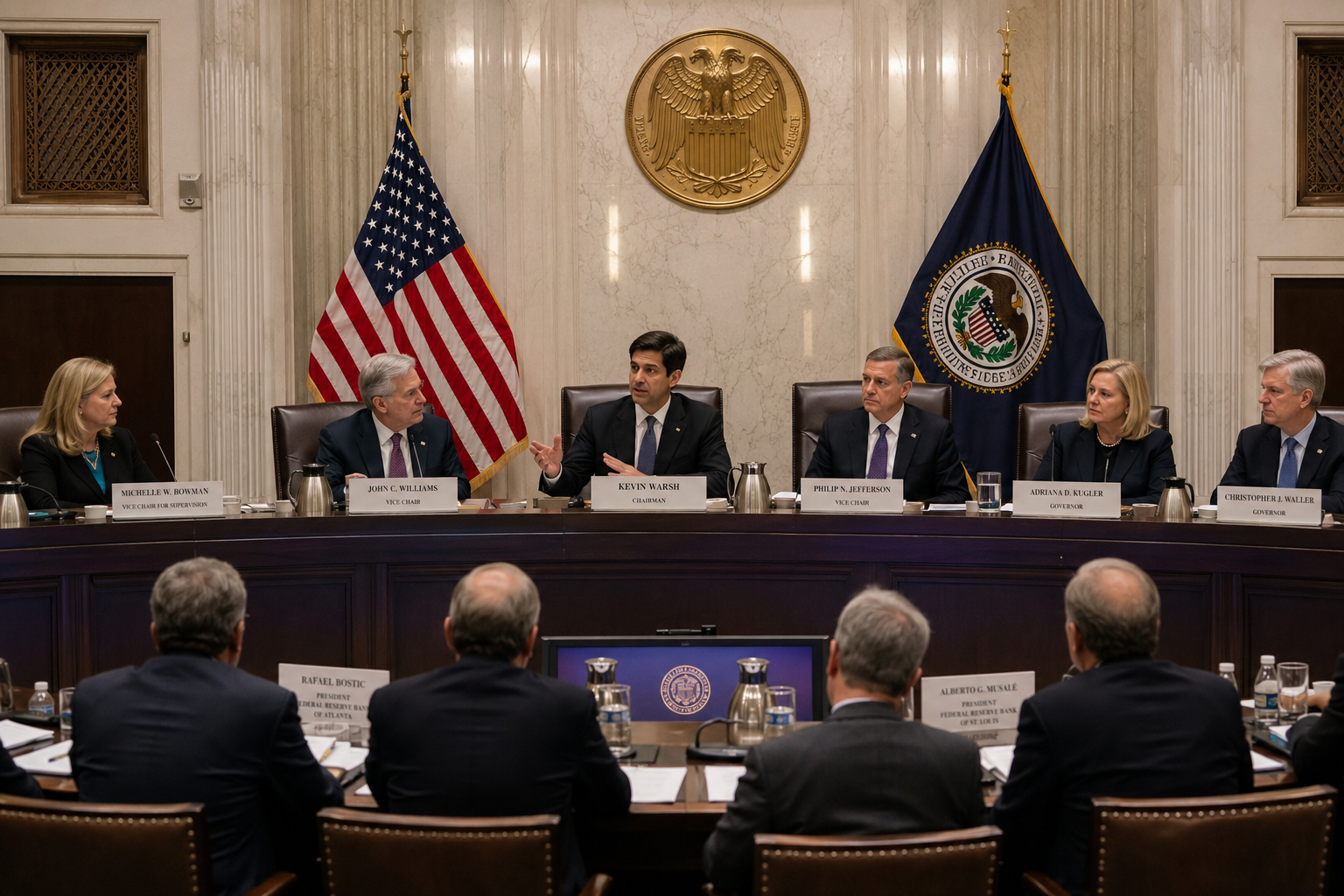
- The FOMC starts today. The two-day session ends Wednesday with a rate decision and press conference from Chair Kevin Warsh. Markets assign a 62% probability of a hold at 3.5% to 3.75%. No dot plot this time, so Warsh's language carries the entire signal. Oil has fallen from $95 to $85 in a week. If he acknowledges the relief, the market hears a dovish tilt.
- The biggest earnings week of the year loads into two nights. Microsoft and Meta report Wednesday after the bell. Apple and Amazon report Thursday. Alphabet's capex raise last week sent its stock down 7%. Every hyperscaler's AI spending guidance gets parsed for acceleration or exhaustion.
- Oil is cratering on the Iran pause. Brent fell below $85 on Tuesday after the US paused strikes for a second night. Oman is mediating Hormuz talks.
- The market signal across all three?
- The Fed, mega-cap earnings, and the Iran ceasefire converge on the same 48-hour window. Position sizing matters this week more than most.
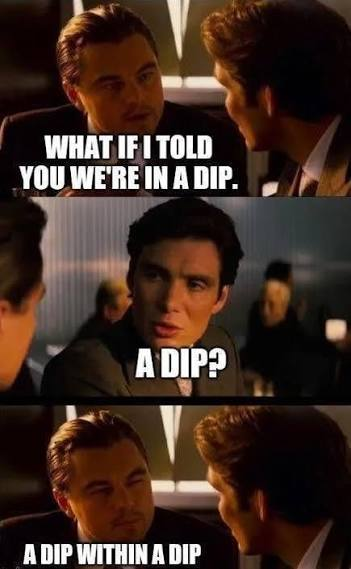
KOSPI investors checking their portfolios these days 👀
That's it for today's Slate. Enormous week. Stay right here.
Today's reply prompt: The AI chip trade just got two cracks in the same week: China building its own machines and Nvidia financing its own customers. Is this the beginning of the unwind, or just a healthy repricing?


