


Good morning, Slaters!
Here is a sentence that should not make sense: Alphabet posted its best quarter in company history last night, and the stock dropped 5%.
Revenue hit $119.8 billion, up 24%. Google Cloud grew 82%. And then management said one number that erased all of it: full-year capex guidance of $205 billion. Thirty minutes later, Tesla told the same story in reverse. Record revenue of $28.24 billion. Operating margin of 1.4%.
Both companies grew faster than anyone expected. Both companies spent faster than anyone was comfortable with.
In 2026, growth without profit discipline is not enough. The question for today is whether the selloff sets the tone for earnings season, or whether the infrastructure names that catch all that spending take the spotlight instead.
Let's get to the signals.
Google Cloud just posted the number. Wall Street didn't care.
Start with the number that should have been the headline: 82%. That is how fast Google Cloud grew in Q2, accelerating from 63% last quarter and blowing past the 64% analysts expected. Cloud revenue hit $24.8 billion. The backlog rose to $514 billion. Alphabet (GOOG) shares ticked higher after the release.
Then the earnings call started. CFO Anat Ashkenazi confirmed Alphabet is raising 2026 capex guidance to $195 to $205 billion. Q2 capex alone was $44.9 billion, double the year-ago figure. And the headline $9.11 EPS? Roughly $6 of it came from a $99 billion unrealized gain on equity stakes in SpaceX and Anthropic. Strip that away and core operating EPS was roughly $2.90, barely above consensus. By 7 p.m. ET, GOOG was down nearly 5%.
The market signal?
Cloud growth at 82% proves the AI buildout is accelerating, not plateauing. But the capex raise tells investors that the cost of staying in the race is rising faster than the revenue it generates. Microsoft, Meta, and Amazon report next week. Every one of them faces the same question: how much is too much?
Buffett's Famous ‘Phone Rule’ Could Make This Company Soar

Warren Buffett famously said, “If you don't find a way to make money while you sleep, you will work until you die.”
What if your phone could do it for you? 📲
That’s exactly what Mode Mobile has created — technology that turns idle phone time into passive income. With 490M+ users in their ecosystem and $1B in earnings and savings, their EarnPhone is being called the Uber of smartphones.
With 32,481% revenue growth and a newly secured Nasdaq ticker $MODE, investors can access their pre-IPO offering at $0.52/share.
Tap into a $1T opportunity — invest now at just $0.52/share and get up to 20% bonus!
Disclaimer: Please read the offering circular and related risks at invest.modemobile.com. This is a paid advertisement for Mode Mobile’s Regulation A+ Offering. Mode Mobile recently received their ticker reservation with Nasdaq ($MODE), indicating an intent to IPO in the next 24 months. An intent to IPO is no guarantee that an actual IPO will occur. The Deloitte rankings are based on submitted applications and public company database research, with winners selected based on their fiscal-year revenue growth percentage over a three-year period.
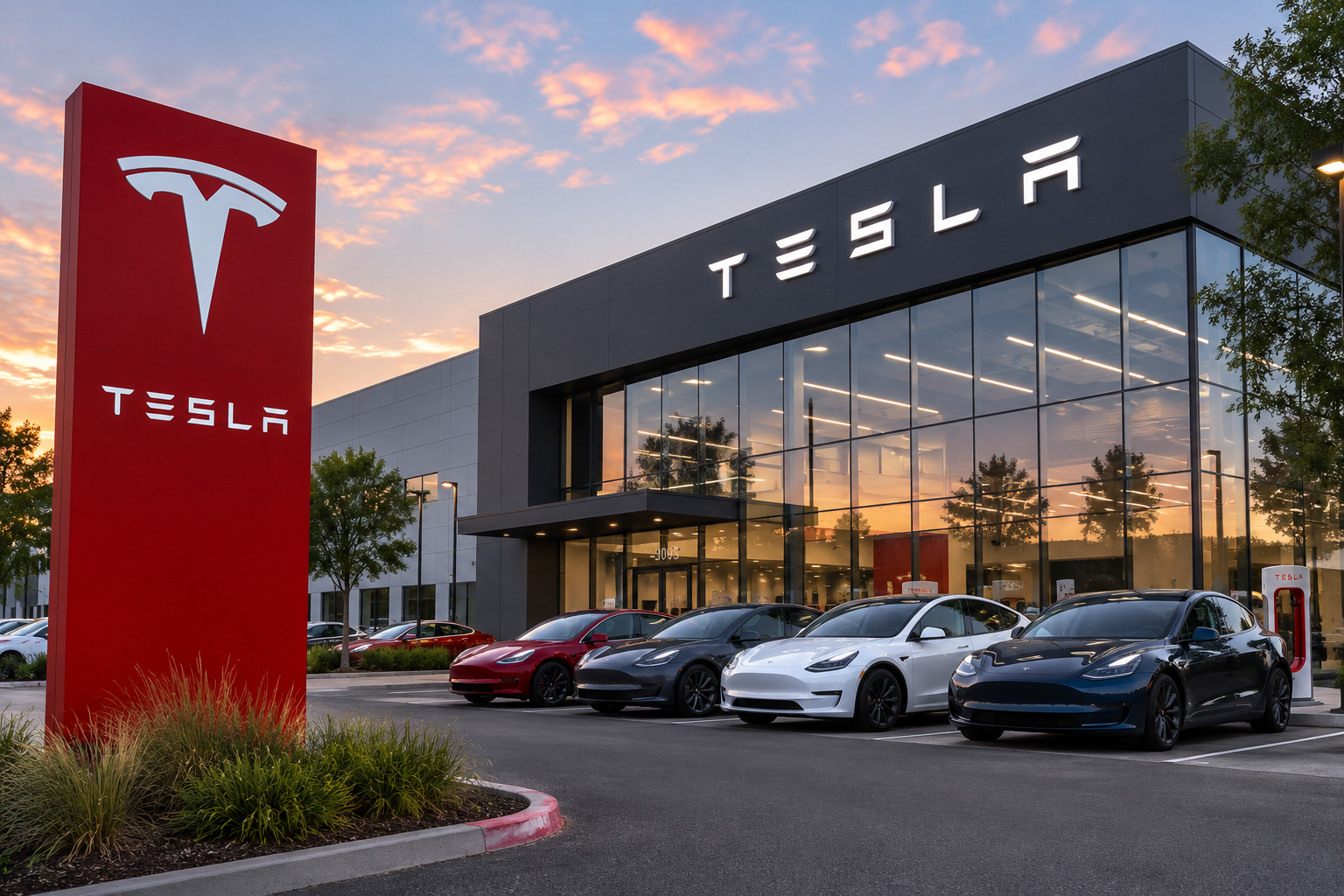
Tesla proved it can sell cars. It forgot to make money.
Tesla (TSLA) delivered record Q2 revenue of $28.24 billion, up 26%, with 480,126 vehicles delivered. The Street wanted $0.51 in adjusted earnings. Tesla delivered $0.33. A 39% miss.
GAAP operating income fell 57% to $398 million, squeezed by lower vehicle pricing, a collapse in regulatory credits, and a 47% surge in operating expenses tied to AI and robotics R&D. Operating margin: 1.4%, down from 4.1%. Capex surged 142% to $5.79 billion. Free cash flow swung to negative $1.09 billion, the first cash burn in more than two years. And the GAAP net income of $1.11 billion? Roughly $763 million of it was paper gains on Tesla's SpaceX stake, most of which has since evaporated as SPCX dropped 27%.
The market signal?
Tesla is spending like an AI company while being valued as a car company. FSD subscriptions hit 1.48 million, up 56%. Robotaxi is live in seven metros. If those lines scale, the margin story reverses. If they don't, a $1.42 trillion market cap on 1.4% operating margin is very fragile.
Super Micro just dropped the loudest preliminary update of the year
While Alphabet and Tesla dominated after-hours, the strongest AI hardware signal came from a much smaller company during the regular session.
Super Micro Computer (SMCI) disclosed more than $60 billion in new orders during its fiscal fourth quarter ended June 30. Backlog hit a record. Gross margin guidance: 15% to 17%, nearly double the 8.2% to 8.4% guided in May. The stock surged 20%. Dell (DELL) jumped 10.2% in sympathy.
At the centre of the order surge: CEO Charles Liang disclosed last month that Super Micro is co-building a gigawatt-scale AI data centre for SpaceX and xAI. The customer mix shift from commodity servers to high-value integrated rack systems is what doubled margins.
The market signal?
When Alphabet and Tesla's combined $250 billion in annual capex flows downhill, the rack builders catch it first. The AI infrastructure cycle just got another data point confirming years of embedded demand ahead.
You’re Being LIED To About The Iran War

Forget EVERYTHING you’ve heard about the Iran war.
Especially the reasons why we’re bombing the country.
Trump just put a two-year clock on 90% of America's prescriptions
This one is not a market story yet. It will be.
Late Tuesday, Trump posted on Truth Social that all generic drugs imported into the US will face 100% tariffs starting August 2028, rising to 200% in August 2029. Two years at zero. Then a cliff.
Generic drugs account for 90% of prescriptions filled in the US. India supplies more than 50% of those generics. China provides roughly 95% of certain key starting ingredients. Building a pharmaceutical plant takes five to seven years. The two-year window does not match the construction timeline. That means this tariff is more likely to function as a price increase than a reshoring mechanism.
The market signal?
Watch Indian pharma ADRs and US generic manufacturers like Teva and Viatris. The two-year fuse means no immediate earnings hit. But for any company modelling drug costs for 2028 and beyond, the math just changed.
WARNING: A Major Market Shift Could Hit Stocks in 2026
If you have any money in the stock market, you may want to pay attention.
New research points to a massive market-moving event that could send hundreds of popular stocks into a sudden free fall.
Holding the wrong stocks when this hits could erase years of gains.
That’s why analysts have now identified a list of stocks investors may want to avoid as this event unfolds.
If you want to see what’s coming — and which stocks could be most at risk —
- ServiceNow (NOW) delivered a strong Q2: revenue of $3.99 billion, up 24%, EPS of $0.90 beating the $0.85 consensus. The headline: AI crossed $1 billion in annual contract value for the first time. The stock had fallen 33% year-to-date. If ServiceNow's AI story holds, it is the clearest "SaaSpocalypse" rebuttal since Snowflake in May.
- Oil surged to its highest in over a month, Brent settling at $94.07 after the 11th consecutive round of US strikes on Iran. The 10-year yield ticked to 4.66%. Every dollar higher on Brent feeds directly into the inflation prints the Fed watches.
- The market signal across both?
- Software is proving AI revenue is real. Oil is rebuilding the inflation pressure that keeps the Fed frozen. Those two forces are running in opposite directions.
Companies in the earnings season be like…

That's it for today's Slate.
The biggest earnings night of the year is in the books. Today's session will tell us whether the after-hours selloff in GOOG and TSLA sticks, or whether the infrastructure beneficiaries take the spotlight.
Stay close to the signals.
Today's reply prompt: Alphabet grew Cloud 82% and still fell. Is the market right, or is this the buying opportunity of the quarter?


