


Good morning, Slaters!
The last time the S&P 500 posted a weekly loss, it was late July.
That streak ended Friday, quietly, on Treasury yields that would not stop climbing even as the Treasury Department itself was trying to shove them lower with the biggest buyback operation of the year. Green on the day, red on the week. The kind of tape that doesn't want to admit what it just did.
Then the weekend arrived and did the admitting. The US imposed 50% tariffs on $20 billion of Canadian goods at midnight Saturday. Prime Minister Mark Carney told reporters his country was "at war." Nvidia warned its largest customers that server prices are going up more than 15% because memory chips have gone uncontrollable. Bitcoin ran another 22% and gold closed at $4,569, the "debasement trade" doing exactly what it says on the tin.
And Kevin Warsh, three months into being Fed chair, is less than a week away from his first Jackson Hole keynote, carrying market pricing that says there is a roughly one-in-three chance he raises rates in September, not cuts.
None of this is quiet. Let's get into it.
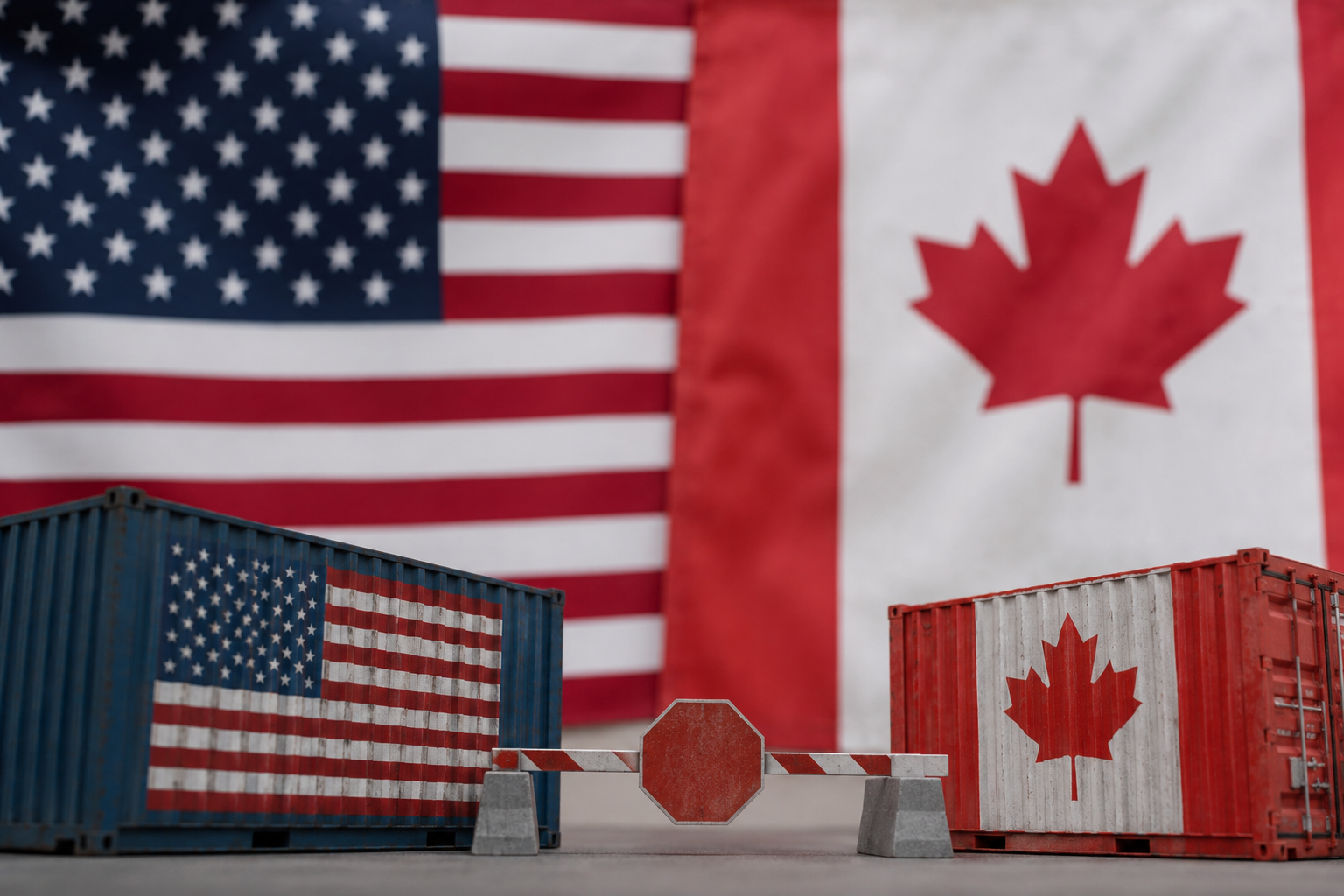
Canada just went "at war." And the numbers underneath say why.
At 12:01 a.m. Saturday, the White House flipped the switch on 50% tariffs against roughly $20 billion of Canadian goods: steel, aluminum, alcohol, hockey equipment, cement, dairy, tongue depressors. The invocation was Section 338 of the Tariff Act of 1930, a provision that has never been used since it became law. Ninety-six years of restraint, ended between a Tuesday deal announcement and a Friday collapse.
Prime Minister Mark Carney told reporters in Ottawa Saturday that Washington's demands had been "uneconomic, unfair, and undermined the net benefits for Canada." Asked why it felt like he was going to war, he answered: "Because we were attacked." Retaliatory tariffs, dollar for dollar, take effect Sept 8 on US steel, dairy, appliances, agricultural equipment, pulp and paper, and electronics.
Now the numbers. US-Canada trade totalled $376 billion in the first half of 2026, roughly double what the US does with China. Canada is the number-one destination for goods from more than half of US states. When retaliation lands Sept 8, it hits farm belts, appliance plants, and paper mills across Wisconsin, Michigan, Ohio, and Pennsylvania. The domestic political cost will be legible on cable news very quickly.
Carney also pointed at the piece markets have been slowest to price. Canadian crude, potash, and critical minerals were deliberately carved out of Saturday's tariffs. That carve-out is doing enormous work: it is why WTI did not gap higher Sunday evening. It is also the pressure point Ottawa now controls. If this escalates, energy is the last card, and Alberta ships nearly 4 million barrels a day into US refineries.
The market signal?
The Section 338 precedent is the story underneath the tariff number. Every major US trading partner just watched the White House use a statute nobody has touched in nearly a century, on the second-largest partner, on a Saturday, without a deal in hand. Expect risk premium on cross-border industrials and dairy-exposed food names to widen this week, and watch the Canadian dollar on Sept 8.
Nuclear Stocks Are Doing Something Unexpected
Nuclear energy is moving back into the spotlight as power demand surges and grid reliability becomes a priority.
Cash flow is improving, long-term contracts are locking in revenue, and capital is rushing back into parts of the sector that were ignored for years.
Our analysts believe this shift is happening faster than most investors realize.
Their FREE report reveals 7 Top Nuclear Stocks to Buy Now — including high-growth uranium plays and steadier contract-backed names.
Get the full list free now before it disappears behind the paywall.
The debasement trade ate the tape
There is a specific kind of week when the safe assets and the risk assets both rip and the middle of the market bleeds. This was that week.
Bitcoin closed Friday above $77,000, up more than 22% for the week, its best five-day run since October. December gold futures hit $4,569.40 per ounce Friday, the highest since May 15, on track for a fifth straight weekly gain. Robinhood jumped nearly 14% Friday alone. Coinbase added 8%. Healthcare had its best week since June.
The actual equity indexes: S&P 7,674.37, Nasdaq 26,180.45, Dow 53,277.01. Up on the day, down for the week. Retail was the worst-performing sub-sector, with Advance Auto Parts down roughly 25% and Walmart down 11%. Both stocks logged their worst weeks since 2023 and 2022.
Read it together. Capital is not fleeing risk. It is fleeing the middle. Money is flowing simultaneously into scarce assets, gold, Bitcoin, high-conviction healthcare, and out of the crowded, expensive, consumer-exposed part of the tape. Classic debasement pattern. And it is happening while CME FedWatch prices roughly a 30% chance of a September rate hike, not a cut. Yields on the 10-year kept grinding higher even as the Treasury doubled long-end buybacks. That is what the bond market sends when it thinks the sovereign is spending faster than the buyer of last resort can absorb.
The market signal?
As long as gold holds above $4,400 and Bitcoin stays above $70,000, the debasement bid is in charge and index-level breadth will keep narrowing. A sustained break below either level, together with a hawkish Warsh Friday, flips this into full risk-off very quickly.
Kevin Warsh, a blank piece of paper, and the podium he's about to walk to
Fed Chair Kevin Warsh takes the Jackson Hole stage Friday, August 28, for the most important twenty minutes of his tenure so far. He has been chair for three months and one day. He has spent that entire tenure telling the market as little as possible.
The context matters. In Warsh's second FOMC meeting on July 29, the committee voted 9-3 to hold rates at 3.50%-3.75%. The three dissenters, Lorie Logan of Dallas, Beth Hammack of Cleveland, and Neel Kashkari of Minneapolis, all wanted to hike. Immediately. That is unusually high dissent this early in a chair's tenure, and it comes from the direction market pricing keeps flirting with. Roughly half the committee penciled in rate hikes for the balance of 2026 at Warsh's first meeting in June.
Since taking office in May, Warsh has systematically dismantled Powell-era transparency. Post-meeting statements shortened. Forward guidance curtailed. His own dot on the dot plot withheld. Asked at the July 29 press conference what Friday's speech would contain, he told reporters it was "a blank piece of paper right now" and added that the Fed "is not constrained by market prices."
That second sentence matters. Markets are pricing a 30% chance of a September hike. Warsh has now told them, twice, he does not consider that pricing binding. The symposium's theme, "Financial Innovation: Implications for Payments and Policy," sounds academic and constrains nothing. Powell used his 2022 Jackson Hole slot under a similarly benign theme to deliver an eight-minute speech that ended a bull market and cost the S&P 3.4% on the day. Bank of America's fund manager survey has 69% of respondents expecting Warsh to be neutral. Neutral is priced in.
The market signal?
Anything even mildly hawkish from Warsh reprices September odds toward 50-50 and puts real pressure on the front end, gold, and long-duration equities. Anything even mildly dovish, and the debasement trade above gets its next accelerant. Friday is the largest single-day macro event risk of the quarter.
The Closest Thing to a Virtual AI Monopoly Wall Street Is Ignoring

A little-known company is building what may be the closest thing to a virtual monopoly the AI era has ever seen.
Only 3...
Yet it beat Apple, Amazon, and the S&P 500 combined...
While paying out $146,000 in total dividends on a 1,000-share stake.
Kevin O'Leary calls what it controls a "unicorn."
Right now, it's trading at a rare discount.
>>>Whitney Tilson reveals the name, completely free.<<<
This ad is sent on behalf of Stansberry Research, 1125 N Charles St, Baltimore, MD 21201. If you would like to optout from receiving offers from Stansberry Research please click here.
Nvidia just told its biggest customers the bill is going up 15%
Late Saturday, Bloomberg reported that some of Nvidia's (NVDA) largest customers have been informed that servers containing its flagship Vera Rubin and Grace Blackwell chips will rise by more than 15% on systems shipped early next year. The reason is not demand. It is memory.
DRAM prices have gone vertical. Samsung Electronics, SK Hynix (000660.KS), and Micron Technology (MU) collectively make substantially all of the world's advanced DRAM, and AI training demand has repriced their leverage. Apple (AAPL) and Qualcomm (QCOM) have both told the market in the past month they are raising end-product prices because of memory costs. Nvidia is the newest name on that list, and the biggest.
Read the transmission carefully. Nvidia runs a 75% gross margin. When a company at 75% gross margin passes a 15% input cost hike through to Microsoft, Alphabet, Oracle, and Meta rather than absorbing it, it is telling you two things. Nvidia has decided AI capex customers have no alternative and will pay. And the memory oligopoly now has enough pricing power to charge the most valuable company on earth. The old story was that Nvidia commanded the AI value chain. The updated story is that Nvidia commands most of it and rents the rest from three memory makers who just took a raise.
The market signal?
Long Samsung, SK Hynix, and Micron on any Nvidia margin miss. Watch Dell (DELL) and Hewlett Packard Enterprise (HPE) this week: they are actually building the servers being repriced, and their margin math changes first.
$4 billion in bearish crypto bets just got vaporized
Bitcoin's 22% weekly rally was not just the debasement trade or the Treasury buyback or Trump's Wednesday White House crypto conference. Underneath, there was a much more mechanical story, and it explains why the move was as violent as it was.
Coming into the week, traders were heavily positioned short Bitcoin. The token had struggled all summer, from a January high near $95,000 to below $60,000 by early July, then sideways for six weeks. Option desks had built structures assuming that range would hold. When Bessent doubled the long-end bond buyback mid-week, capital parked in the dollar and Treasurys started rotating out. Some landed in Bitcoin. Prices ticked up.
Then the short squeeze engaged. As Bitcoin rose past $70,000, shorts started getting stopped out. Closing a short means buying the asset. That buying pushed price higher, which triggered more stops, which required more buying. By Friday, more than $4 billion in bearish crypto positions had been liquidated, per CoinGlass. The rally became self-reinforcing not because new bulls arrived, but because old bears were forced out.
This is how modern crypto moves work in a way stock moves usually don't. The derivatives market is enormous relative to spot, leverage often runs 20-50x, and stop-outs cascade in ways that are functionally invisible in traditional equities. The debasement trade explains why capital wanted in. The short squeeze explains why the price moved as fast as it did. Anyone modelling Bitcoin as "a risk asset that trades like the Nasdaq with more decimals" got shown, again, that the plumbing is different.
WARNING: A Major Market Shift Could Hit Stocks in 2026
If you have any money in the stock market, you may want to pay attention.
New research points to a massive market-moving event that could send hundreds of popular stocks into a sudden free fall.
Holding the wrong stocks when this hits could erase years of gains.
That’s why analysts have now identified a list of stocks investors may want to avoid as this event unfolds.
If you want to see what’s coming — and which stocks could be most at risk —
- Wednesday delivers the July PCE print alongside Nvidia's Q2 earnings after the close. The Fed's preferred inflation gauge is expected to nudge higher again on energy pass-through, 48 hours before Warsh speaks. A hotter number hands the three dissenters new ammunition and reprices Sept hike odds sharply, right before the chair takes the mic.
- The Cook removal deadline is Tuesday, August 26. Governor Lisa Cook has until then to respond to the White House letter on mortgage-fraud allegations. Her lawyers have already said there is "no valid cause." If the administration moves to fire her the day after, it lands in the middle of Jackson Hole week and puts Fed independence on the front page of every business paper before Warsh speaks.
- Jackson Hole opens Thursday at Jackson Lake Lodge. Warsh keynotes Friday. Bank of England Governor Andrew Bailey and ECB President Christine Lagarde speak the same weekend. Expect pricing to whip around every headline out of Wyoming from Thursday afternoon on.
- The market signal across all three? This is the most compressed macro week of the quarter. PCE, Nvidia, Cook, Warsh, plus Canada retaliation queued for the following Tuesday. Sizing down is the least imaginative and often the smartest move heading into a week this dense.

That's it for today's Slate.
A dense week loading. Stay close to the feed.
Today's reply prompt: Where do you have Warsh landing Friday: hike-signaling, dovish surprise, or neutral?


