Good morning, Slaters!Two things are happening this morning that have absolutely nothing to do with each other. Except they do. In Seoul, the KOSPI crashed below 6,000 overnight. Circuit breakers fired. SK Hynix and Samsung fell double digits. The trigger: fresh fears that China's memory chip industry is expanding faster than anyone expected, and a report that Chinese companies have begun mass-producing DUV lithography equipment. The AI hardware trade, which made everyone rich in the first half of this year, is now making some of those same people very nervous. And in New York, JPMorgan Chase, Goldman Sachs, Wells Fargo and Citigroup are about to release Q3 earnings. All four report before the bell. These are the first major results of the quarter, and they arrive into a market sitting near record highs with a 10-year Treasury yield above 5.2%. Bank earnings have historically set the tone for every earnings season this cycle. So the question for Tuesday is simple. Does the money follow the chip fear or the earnings hope? Because both are landing at the same time, and they are pulling in opposite directions. Let's find out. 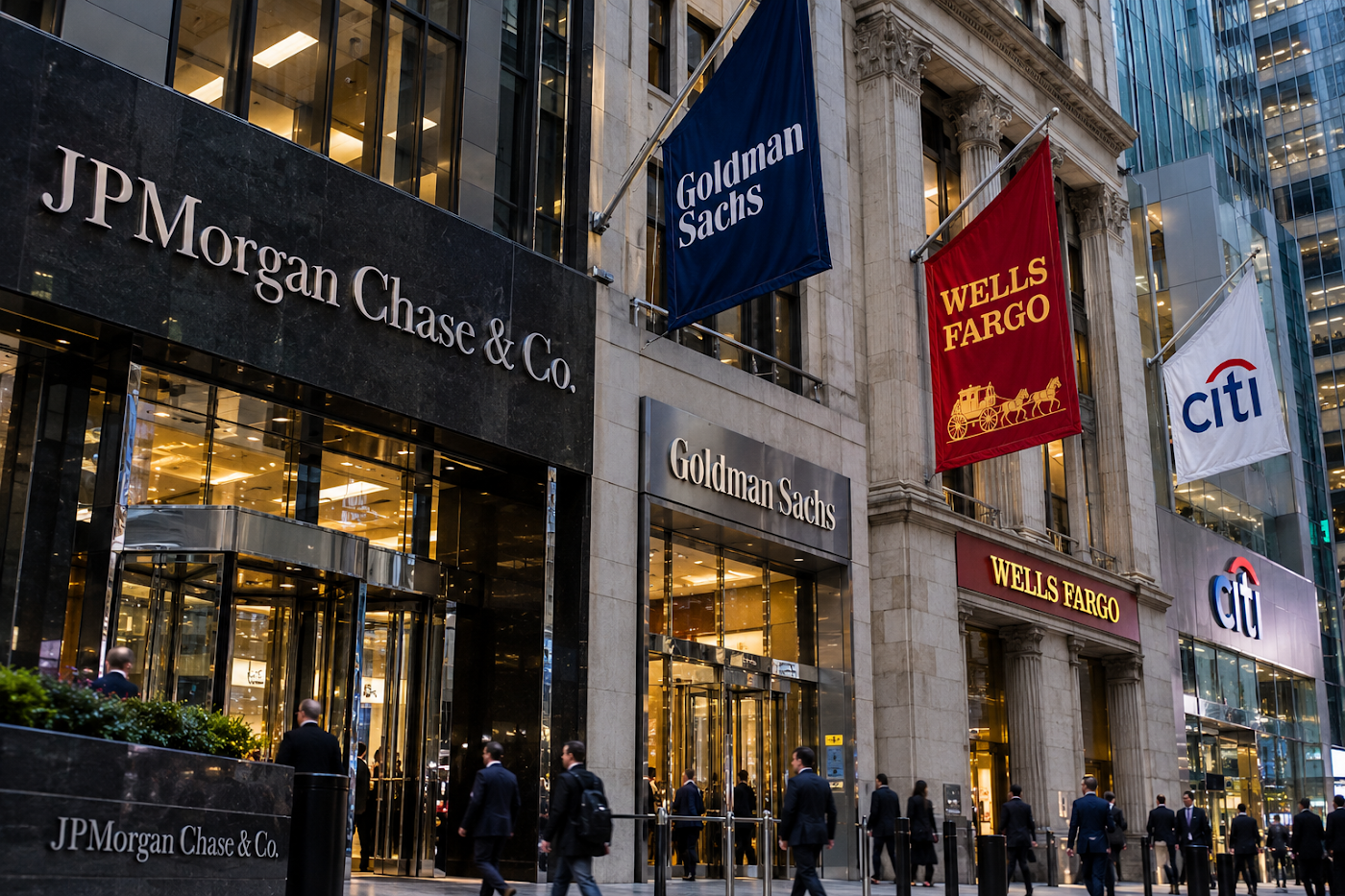
Daybreak Four banks, one morning, and the question Wall Street has been rehearsing all weekEarnings season opens with the heaviest possible lineup. JPMorgan Chase (JPM) reports at approximately 7:00 AM ET. Goldman Sachs (GS) follows at 7:30 AM. Wells Fargo (WFC) and Citigroup (C) land around the same window. By the time the opening bell rings, the entire financial sector's narrative will be set. The consensus expectations are robust. Analysts expect JPMorgan to post roughly $5.82 to $5.93 per share on approximately $51 billion in revenue, up from $5.07 a year ago. Goldman is expected to earn approximately $12.44 to $12.87 per share on $16.8 billion in revenue. Wells Fargo consensus sits near $1.85 on $22.4 billion. But the numbers alone are not the story. The real question is what earnings quality looks like against the yield backdrop. The 10-year Treasury closed Monday above 5.19%. The curve has been steepening from the wrong end for weeks, with the long end rising on term-premium repricing, not rate-cut expectations. For banks, higher yields are typically good for net interest income. But they also pressure loan demand, slow investment banking pipelines, and create unrealised losses in bond portfolios. Last quarter was extraordinary. Goldman's Q2 was the best in its history at $20.34 billion in net revenue. JPMorgan said every line of business hit a record. Analysts expect the five major investment banks to generate roughly $38 billion of combined trading revenue in Q3, compared with a record $47 billion in Q2. That is a meaningful step-down. The market signal? Beat-and-raise from JPMorgan sets a bullish floor under the entire S&P 500 earnings cycle. A miss on net interest income guidance from Wells Fargo reopens the "rates too high for too long" narrative. Both scenarios are live before 8 AM. PREMIER FEATURE Carnegie didn't invent steel. He used new technology to produce it cheaper and faster than anyone on Earth. Rockefeller didn't discover oil. He used industrial machinery to refine it more efficiently. Vanderbilt didn't build the railroad. He understood that whoever controlled the infrastructure controlled the economy. Their combined fortunes were between $700 billion and $1 trillion. Best-selling financial author Alexander Green has identified three companies positioned to be the Titans of the AI age. CLICK HERE TO FIND OUT WHO THEY BEFORE THE WINDOW CLOSES Pulse Check Seoul just had a very bad morningThe KOSPI fell below 6,000 for the first time since April, triggering two circuit breakers during the session. SK Hynix plunged more than 10%. Samsung fell over 8%. Taiwan Semiconductor Manufacturing Company (TSM) retreated in Taipei. MSCI's Asia Pacific equities gauge dropped 2%, heading for its weakest close since August. Two things drove the selling. First, fresh reports that ChangXin Memory Technologies, the Chinese DRAM maker whose blockbuster Shanghai IPO in July valued it near $487 billion, is planning a higher-density server memory product by the end of 2026. That directly threatens the high-bandwidth memory segment where SK Hynix and Samsung have dominated with near-monopoly pricing power. Second, reports emerged that a Chinese state-backed company has begun mass production of homegrown DUV lithography tools. If confirmed at commercial scale, this would represent a significant step toward breaking the Western equipment monopoly that has constrained China's chip ambitions for years. The contagion has already reached US premarket. Micron Technology (MU) was down nearly 5% before the open. SanDisk (SNDK) slid further. Intel (INTC) dropped more than 3% on Monday and was weakening again. Foreign investors have now net sold more than $6 billion of KOSPI shares in October alone. The index remains up roughly 49% for the year, but that cushion is eroding fast. The market signal? If Micron holds its premarket lows at the open, the damage may be contained to memory. If it accelerates, the broader semiconductor complex, including Nvidia (NVDA) at $226, gets dragged in. Watch the VanEck Semiconductor ETF (SMH) in the first 30 minutes. Who Moved the Mic? Wells Fargo and BofA just drew opposite conclusions about AI and softwareTwo analyst calls landed Monday morning that, placed side by side, tell you exactly where the fault line is running through enterprise software. Wells Fargo downgraded Adobe (ADBE) to underweight from equal weight, saying third-quarter results showed "meaningful cracks" in the growth profile. The analyst cited muted results and a deteriorating competitive position as AI-native tools chip away at Creative Cloud's dominance. ADBE slid more than 2% on the call. Meanwhile, Bank of America upgraded Salesforce (CRM) to buy from underperform, arguing that large enterprises are unlikely to abandon the platforms that house their data. CRM jumped 4% in early trading. BofA's thesis: the "AI kills software" narrative has been overblown for companies that own the data layer. Put the two calls together and you get a framework. AI is genuinely disrupting software categories where the core workflow can be replicated cheaply. Tax prep. Image generation. Code completion. Adobe's Creative Cloud sits uncomfortably close to that zone, with competitors like Midjourney and Canva eating market share from the bottom. But AI is not disrupting categories where the software is the system of record. CRM databases. ERP systems. Data warehouses. Salesforce's $67.9 billion backlog and Snowflake's 38% RPO growth earlier this year point in the same direction: the companies that own the enterprise data graph are becoming more valuable in the AI era, not less. William Blair also recently cut Adobe to market perform, citing "intense competition that raises legitimate questions about what the future looks like." ADBE is now down over 27% year-to-date, trading near $243. The market signal? The divergence is not about two analyst notes. It is about which software business models survive the AI compression cycle. Companies where AI replaces the workflow face structural headwinds. Companies where AI runs on the data inside the workflow are infrastructure. Investors are now pricing that distinction in real time. Beyond the Candles CPI is 24 hours away. The Fed meeting is two weeks out. This is the setup.Wednesday at 8:30 AM ET, the Bureau of Labor Statistics releases the September CPI report. Core CPI expectations cluster around 0.2% month-on-month and 2.4% year-on-year. The FOMC meets on October 28, exactly two weeks later. Fed Governor Waller warned on October 8 that persistent inflation could become embedded in expectations. The August CPI release showed shelter inflation holding at 3.0% year-on-year with airfares running at a striking 23.4%. The headline numbers have been moderating, but the composition still has pockets of stickiness that give hawkish Fed members ammunition. The market is not pricing a rate cut. It is pricing the possibility that Warsh's Fed might hike again. The 10-year yield above 5.19% reflects that ambiguity. And the S&P 500 sitting near all-time highs with that yield backdrop is, as we noted in August, a duration bet dressed in growth clothing. A hot CPI print, anything above 0.3% month-on-month on headline, would materially shift the odds toward a hike at the October 28 meeting. A cool print would give the doves their first clean argument since summer. The market signal? Wednesday morning is the single most important data point between now and the FOMC. Position sizing today should reflect the fact that CPI lands before tomorrow's open. Under the Hood Elon Musk just became the biggest known donor of the 2026 midtermsThis one is not about chips or earnings. It is about what happens when the wealthiest person on Earth decides to buy influence at scale. CNBC reported Monday that Elon Musk has become the single largest known individual donor of the 2026 midterm election cycle. The exact figures remain partially undisclosed, but filings show contributions flowing through multiple political action committees and Super PACs backing candidates aligned with deregulation, AI policy, and space industry funding. This matters to markets for a specific reason. Musk controls Tesla (TSLA), SpaceX (SPCX), xAI, Neuralink, and The Boring Company. He sits at the intersection of electric vehicles, space, AI, tunneling infrastructure, and brain-computer interfaces. Every one of those industries has regulatory exposure. And midterm elections determine which congressional committees write the rules. The deeper pattern: the 2026 cycle is the first where AI policy is a campaign issue at scale. Candidates are running on positions about compute export controls, AI liability, autonomous weapons, and data privacy. The funders backing them are not abstract donors. They are the CEOs whose companies will be regulated by the committees those candidates join. The market signal? Watch AI-adjacent policy stocks around the November midterms. Companies with direct regulatory exposure, from autonomous vehicles to defence AI, are now correlated with election outcomes in a way they were not two years ago. SPONSOR SPOTLIGHT The Closest Thing to a Virtual AI Monopoly Wall Street Is Ignoring
A little-known company is building what may be the closest thing to a virtual monopoly the AI era has ever seen. Only 3... Yet it beat Apple, Amazon, and the S&P 500 combined... While paying out $146,000 in total dividends on a 1,000-share stake. Kevin O'Leary calls what it controls a "unicorn." Right now, it's trading at a rare discount. >>>Whitney Tilson reveals the name, completely free.<<< This ad is sent on behalf of Stansberry Research, 1125 N Charles St, Baltimore, MD 21201. If you would like to optout from receiving offers from Stansberry Research please click here. What's Brewing - CPI lands Wednesday at 8:30 AM ET, and the FOMC meets October 28. If September headline CPI comes in above 0.3% month-on-month, the probability of an October hike jumps meaningfully. A clean 0.2% print would give rate-sensitive sectors a brief exhale. The BLS release schedule confirms the Wednesday morning window.
- Bank of America (BAC) and Morgan Stanley (MS) report Q3 earnings Wednesday morning, extending the bank earnings wave. Morgan Stanley's record equity trading revenue in Q2, $6.3 billion, set an extremely high bar for the sequential comparison.
- The chip selloff has a built-in test this week. If the KOSPI stabilises by Thursday and US memory names find buyers, the dip is rotational. If foreign selling in Seoul accelerates past $8 billion for October, the positioning unwind has further to go. Watch SK Hynix ADR volume as the real-time read on whether institutional selling is spent.
- The market signal across all three? Bank earnings set the tone Tuesday, CPI sets the direction Wednesday, and the chip trade determines whether the AI narrative survives the week intact. All three converge into the most consequential 48 hours of Q4.
Meme of the Day 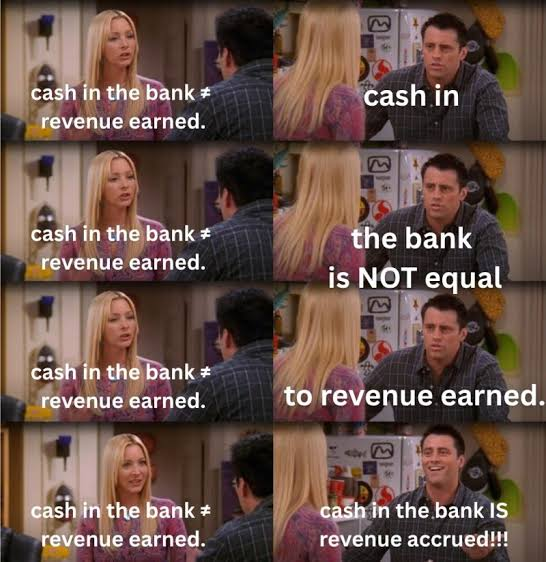
That's it for today's Slate. Biggest earnings morning of the quarter. Stay close to the feed. Today's reply prompt: JPMorgan or Goldman: whose earnings call will move more money today? 3 Stocks at a Major Turning PointSomething unusual is happening beneath the surface of three widely followed stocks.
In each case, the fundamentals are saying one thing... while institutional activity, management signals or the options market are saying something else. That kind of disagreement can matter. Because when the evidence stops lining up, the next move in the story often comes down to a handful of signals most investors never think to watch. Our new FREE Market Tell Special Report breaks down three of these situations, and shows you exactly what we’re watching next. Get the Free Report: 3 Stocks at a Major Turning Point → |