Good morning, Slaters!There is something deeply strange about an economy where the worst jobs number in two years makes investors richer. Friday's September payrolls report landed like a grenade with the pin still in. The US economy added just 29,000 jobs, roughly a third of what economists expected. Unemployment ticked up to 4.2%. Average hourly earnings growth slowed to 3.0% year-over-year, the softest pace in five years. On paper, a report that screams caution. Markets heard something else entirely. The S&P 500 rose 0.73%. The Nasdaq jumped 1.19% to a record intraday high. Nvidia (NVDA) closed at a fresh all-time high. Tesla (TSLA) surged nearly 5% on a delivery beat. And the probability of an October Fed rate hike collapsed from roughly 70% earlier in the week to around 18% by Friday afternoon. Bad news as good news is a familiar trade. What makes this version different is the backdrop it is running against. The 10-year Treasury yield sits at 5.28%. The 30-year is at 5.64%. The bond market has not received the memo that the hike is off the table. And that disconnect, between equity euphoria and fixed-income stubbornness, is the most important tension in markets this week. Let's see who blinks first. 
Daybreak The labor market just handed the doves their best argument in monthsHere is what Friday's BLS report actually said, and what it didn't. Nonfarm payrolls rose by 29,000 in September. The consensus estimate was 84,000 to 90,000. The prior two months were revised lower by a combined 60,000, taking July to negative 10,000 and August down from 162,000 to 133,000. Over the past three months, payrolls have averaged just 51,000 per month. That is the weakest three-month average since mid-2020. The composition mattered. Private-sector hiring added 46,000 jobs, concentrated in healthcare, construction, and leisure. Government employment fell by 17,000, extending a 216,000-job decline over the past year. The household survey told a different story: the labor force expanded by 485,000 people while employment rose by just 406,000, pushing unemployment up to 4.2%. Participation rose to 61.8%. People are entering the workforce. They just aren't all finding work yet. But here is the line that TD Economics called "Goldilocks": average hourly earnings growth decelerated to 0.1% month-over-month and 3.0% year-over-year. The three-month annualized rate is running at just 2.4%. Wage inflation, the thing the Fed was most worried about, is cooling meaningfully. The market signal? CME FedWatch now prices roughly 18 to 20% odds of an October hike, down from approximately 70% a week ago. This report alone probably does not settle the debate. But it hands the doves on the FOMC a concrete data point to wave around at the October 27-28 meeting. Wednesday's FOMC minutes from the September meeting will reveal how close the hawks came to winning that argument last time. PREMIER FEATURE 7 AI Stocks to Lead the Next DecadeAI is fueling the Fourth Industrial Revolution – and these 7 stocks are front and center. One of them makes $40K accelerator chips with a full-stack platform that all but guarantees wide adoption. Another leads warehouse automation, with a $23B backlog – including all 47 distribution centers of a top U.S. retailer – plus a JV to lease robots to mid-market operators. From core infrastructure to automation leaders, these companies and other leaders are all in 7 AI Stocks to Invest in Today. Free today, grab it before the paywall locks. Pulse Check The market rallied. The bond market didn't agree.Friday's scoreboard: the S&P 500 closed at 7,722.72, up 0.73%. The Dow gained 250 points to 51,177. The Nasdaq rose 1.19% to 27,191, touching an intraday record. On the week, the S&P dipped 0.27% while the Nasdaq gained 1.3%. Semiconductors led, with SMH up more than 2%. Nvidia hit a new all-time high. Tesla jumped on the delivery beat. Nike (NKE) sank after results showed revenue declining and Greater China plunging 17%. Now the uncomfortable part. Treasury yields initially dropped on the jobs data, then reversed. The 10-year closed near 5.28%. The 30-year sits at 5.64%. The 2s30s curve is running over 75 basis points of slope, and all of the steepening has come from the long end rising, not the short end falling. Equities are trading like the hike is dead. Bonds are trading like fiscal risk is alive. One of these markets is wrong. The market signal? The VIX is sitting at 15.3, which implies complacency. If ISM Services runs hot this morning (consensus: 55.7, prior: 55.4), bond yields could push higher even as stocks celebrate the jobs miss. The equity-bond divergence is the single most important thing to track this week. Who Moved the Mic? Tesla delivered the beat. Now comes the harder question.Tesla reported Q3 deliveries of 486,532 vehicles on Friday morning. Bloomberg consensus was roughly 463,000. The stock jumped nearly 5% to close at $371 and climbed further in after-hours trading. The quarter was solid. Model 3 and Model Y carried the bulk, as usual. Production came in at 464,391 units, meaning Tesla delivered more cars than it built for the second consecutive quarter, which is a deliberate inventory drawdown. Year-over-year, deliveries fell about 2%, but that comparison is distorted because Q3 2025 was boosted by a tax-credit rush that pulled demand forward. The Cybercab is the piece investors care about more than quarterly deliveries. Tesla's robotaxi launched in Austin in September, but it has been bumpy. NHTSA opened an audit query. Wells Fargo called the launch "underwhelming." About 45 Cybercabs are registered in Texas. Waymo, owned by Alphabet (GOOGL), runs 500,000 autonomous rides per week from nearly 1,000 vehicles. Full Q3 financial results drop October 21, where the real debate happens: margins, pricing power, and Cybercab capex. The market signal? The delivery beat keeps the stock afloat ahead of earnings. But at roughly 165 times forward earnings, Tesla's valuation is pricing in a robotaxi future that has barely started. October 21 is the next inflection. FROM OUR SPONSORS Trump to build "biggest data center on the planet"
America's about to get its first national data center… Completely funded by taxpayer dollars. When it comes online just days from now… This device could change the history of Artificial Intelligence… And even human civilization. (It could also make early investors in this company very happy.) Louis Navellier believes it will secure America's dominance over China in the AI arms race… While completely sidestepping the dangers of Artificial Superintelligence. Donald Trump committed $1 billion to support the stock behind the coming breakthrough right now… Ahead of a potential announcement from the company that could hit soon. Get all the details – down to the company name and ticker – here, in Louis' brand-new presentation. This ad is sent on behalf of InvestorPlace Media at 1125 N. Charles Street, Baltimore, Maryland 21201. If you're not interested in this opportunity, please click here. Beyond the Candles Nvidia is quietly becoming the most valuable company on earth. Again.While the macro data stole the headlines, Nvidia did something worth noting on Friday. It closed at a fresh all-time high, leading the semiconductor complex higher and pushing its market capitalization past $5.5 trillion. Morgan Stanley reinstated Nvidia as a top pick after meeting with CEO Jensen Huang. The bull thesis is unchanged but louder: Rubin GPUs are ramping, data center revenue in Q2 hit $96.2 billion (up 106% year-over-year), and October-quarter consensus sits at roughly $104.8 billion. The stock trades at about 25 times forward earnings. For triple-digit revenue growth, that is cheaper than the semiconductor index on a growth-adjusted basis. One headwind worth flagging: the Dollar Index (DXY) is flirting with 102, near an 18-month high. A strong dollar compresses international earnings across every multinational. If the dollar keeps climbing, it becomes friction even for the best growers. The market signal? Nvidia earnings are not until November 20. Between now and then, the stock's performance will be driven by peer results (Constellation Brands tomorrow, then banks mid-month) and the bond-yield backdrop. If the 10-year stays above 5.25%, the AI trade gets re-underwritten at a higher discount rate, same way it did to Vertiv in August. Demand is not the question. Duration risk is. Under the Hood The trade war nobody in America is watchingWhile markets fixated on jobs and Tesla deliveries, a trade conflict with America's largest trading partner quietly deepened into its seventh week. The US imposed 50% tariffs on roughly $20 billion of Canadian goods on August 22, using Section 338 of the Tariff Act of 1930, a statute that had essentially gathered dust for decades. The trigger? Disputes over American alcoholic beverages, automotive goods, and dairy access in the Canadian market. Canada retaliated on September 8 with surtaxes of 15% to 50% on a broad range of US goods. President Trump then announced that tariffs on Canadian cars and auto parts would rise to 50% starting in January. This is not performative. Canada sends 73% of its exports south. Bilateral goods trade runs at roughly $700 billion annually. USMCA is on annual review and hemorrhaging credibility. The financial angle nobody is discussing: Canadian energy. Canada is the largest source of US crude oil imports. Tariffs on energy flows would feed directly into the gasoline and transport costs that already have PCE inflation running hot. Energy is not yet in the target list. But in trade wars, escalation ladders rarely stop at the convenient floors. The market signal? Auto stocks and Canadian-exposed industrials carry the most direct risk. The Bank of Canada projected potential output growth slowing to just 1.1% in 2026, partly because of US trade policy. If energy enters the tariff conversation, that is an inflation story for both sides of the border. SPONSOR SPOTLIGHT A "bloodbath" Is Coming
Silicon Valley billionaires are hoarding guns, gold, and even military grade gas masks... or fleeing the country altogether. What do they know that you don't? This AI insider is stepping forward with this time-critical message: Move your money before October 31st, ahead of the dangerous next phase of the AI market. Here's the one urgent move you need to make with your money immediately. This ad is sent on behalf of TradeSmith at 1125 N. Charles Street, Baltimore, Maryland 21201. If you're not interested in this opportunity, please click here. What's Brewing - ISM Services PMI drops at 10:00 AM ET this morning. The prior reading was 55.4, consensus 55.7, but the employment subindex fell to 47.8 last month, deep in contraction. If services employment weakens further while prices paid hold above 70, the stagflation narrative gets fresh ammunition.
- Wednesday at 2:00 PM ET, the FOMC releases minutes from its September 15-16 meeting, where the Fed hiked rates and multiple members dissented. The market needs to know how close the hawks came to forcing a second consecutive hike.
- Constellation Brands (STZ) reports fiscal Q2 earnings tomorrow after the close. Consensus is $3.55 EPS on $2.54 billion revenue. The stock is down 13.5% since August 31, at a forward P/E of 9.8 times. If Modelo and Corona depletions are softening, it tells you something broader about discretionary spending in a 5.28% yield world.
- The market signal across all three? The macro picture and the earnings picture are on a collision course this week. ISM and the FOMC minutes pressure rates. Constellation tests the consumer. The answer to "bad news is good news" gets retested from multiple angles before Friday.
Meme of the Day 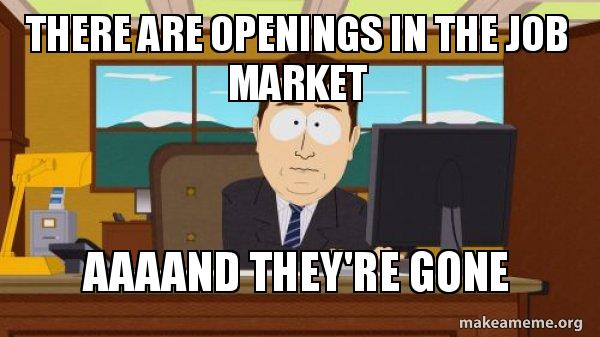
That's it for today's Slate. ISM at 10 AM sets the tone. Stay close to yields. Today's reply prompt: The labor market just cracked. Is this the beginning of something, or a one-month blip? 3 Stocks at a Major Turning PointSomething unusual is happening beneath the surface of three widely followed stocks.
In each case, the fundamentals are saying one thing... while institutional activity, management signals or the options market are saying something else. That kind of disagreement can matter. Because when the evidence stops lining up, the next move in the story often comes down to a handful of signals most investors never think to watch. Our new FREE Market Tell Special Report breaks down three of these situations, and shows you exactly what we’re watching next. Get the Free Report: 3 Stocks at a Major Turning Point → | 


